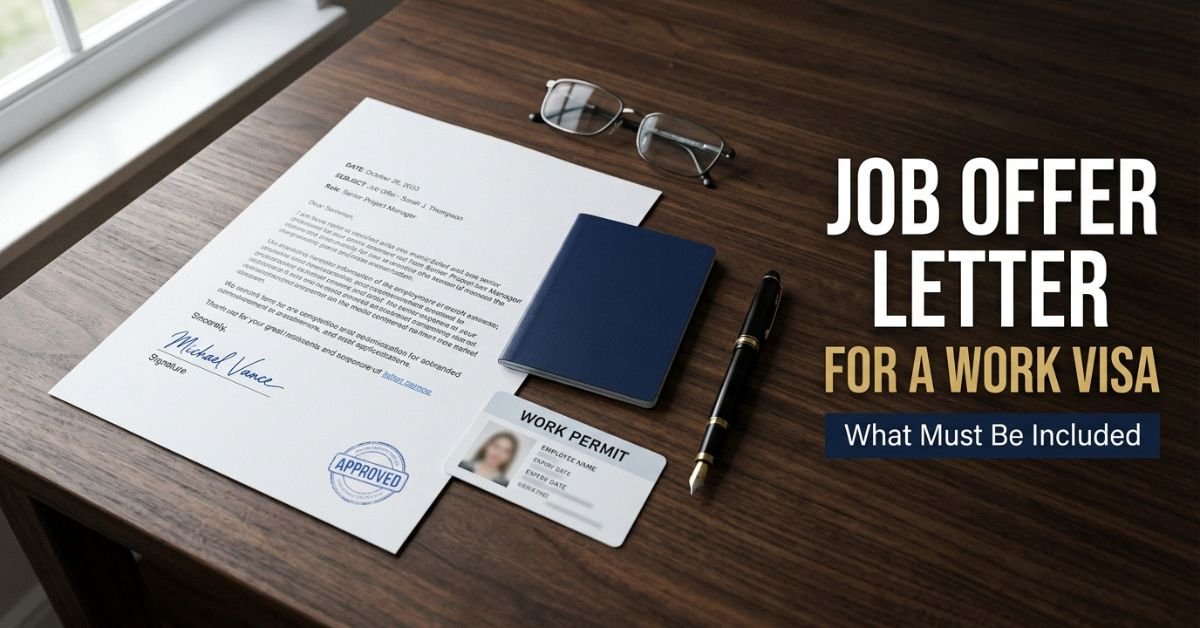
Job Offer Letter Requirements for A Work Visa: What Must Be Included
The job offer letter requirements for a work visa reduce to eleven facts printed on a single page: the employer’s legal identity, your legal name, the job title, the occupation classification, the duties, the workplace address, the start date, the contract length, the weekly hours, the gross salary, and a signature from someone with authority to commit the company. Leave one out and the file waits.
That is the answer most people came for. What follows is the part that decides whether the letter actually works.
Quick Answer: What A Work Visa Job Offer Letter Must Contain
A work visa job offer letter must state the employer’s registered name and address, the applicant’s full legal name exactly as printed in the passport, the job title, the duties, the work location, the start date, the contract duration, the hours per week, and the gross salary in local currency — on company letterhead, signed by an authorised officer.
Key Takeaways
- The letter is supporting evidence, not an application. In most sponsorship systems a separate government-side record carries the legal weight.
- The salary line is tested against a legal minimum, and in many countries that minimum is adjusted on a fixed annual date.
- Every detail must agree with every other document in your file. Inconsistency, not absence, is what most often triggers an information request.
- A letter that arrives with a request for payment, or from a company you cannot independently verify, follows the standard pattern of an employment scam.
By The Numbers
- 11 elements belong on almost every work visa offer letter, regardless of destination
- 4 structural models of sponsorship exist worldwide, and each asks the letter to prove something different
- 2 salary tests usually apply at once: a national floor and an occupation-specific rate
- 1 signature, from one authorised person, is what makes the document count
- 0 verbal amendments should ever be accepted once the letter is issued
The Eleven Elements Every Letter Needs
Start here if this is your first sponsored offer. These items appear, in one form or another, in every serious immigration system on earth, because they answer the four questions an officer has: does this employer exist, does this job exist, is this the right person, and is the pay real.
| # | Element | Why it matters |
|---|---|---|
| 1 | Registered company name and address | Confirms the employer is a real, traceable legal entity |
| 2 | Company letterhead | Visibly ties the document to that entity |
| 3 | Your full legal name as printed in the passport | Prevents identity queries later in the process |
| 4 | Exact job title | Must match the role the permission is granted for |
| 5 | Occupation or classification code | Most systems classify jobs by code, not by title |
| 6 | Specific duties | Demonstrates the role genuinely needs the skill level claimed |
| 7 | Work location | Street address where possible, city and region at minimum |
| 8 | Start date | Anchors the timeline the whole application runs on |
| 9 | Contract duration and type | Fixed-term, ongoing, probationary terms |
| 10 | Hours per week and full or part-time status | Changes how salary thresholds are calculated |
| 11 | Gross annual salary, currency stated | This is the figure the legal minimum is measured against |
| 12 | Signature, printed name and job title of signatory | Proves someone with authority stands behind it |
Two of those carry more weight than the rest.
The duties paragraph. This is where weak letters fail. A description that names the actual responsibilities, the tools or systems involved, the level of independence expected, and the qualification the work genuinely demands does real evidentiary work. A description built from recycled phrases about supporting team objectives does none. The officer is not reading for style; they are checking whether the job could plausibly require the skill level being claimed.
The signature. Authority matters more than seniority. A letter signed by a company director, HR head or line manager with a company email address and a stated job title is credible. One signed by an intermediary with no visible connection to the employer is not, and that weakness spreads to everything attached to it.
The Four Sponsorship Models And What Each Demands
Here is the insight that saves people months. Work visa systems around the world are built on four structural models. Once you know which one your destination uses, you know what your letter has to prove — and, just as importantly, what it cannot achieve on its own.
| Model | How permission is created | What the letter must do |
|---|---|---|
| Wage attestation | Employer files a formal wage undertaking with a labour authority before the immigration petition | Carry exactly the same wage and job classification as the filing |
| Sponsor licence | Employer holds a licence and issues a numbered sponsorship record for the individual | Mirror the salary, occupation code and duties on that record |
| Labour market test | Employer proves no local worker was available before permission is granted | Describe a role that matches the advertised vacancy precisely |
| Contract-based | The signed employment contract is itself the core application document | Be binding, complete, and match the applicant’s qualification |
Wage Attestation Systems
In these systems, the employer first commits to a legally determined wage for the occupation in that location, then files the immigration petition. The offer letter is corroboration. Its only job is to say the same thing as the wage filing.
The practical risk here is arithmetic. A letter promising a higher salary than the filing suggests one document is wrong. A letter promising less suggests the undertaking will not be honoured. Either way, the officer has to ask. Before you sign, confirm the figure on your letter is the same figure the employer submitted, to the currency unit.
Sponsor Licence Systems
Here the employer must be pre-approved to sponsor foreign workers at all, and issues a numbered record tied to you personally. That record not the letter is what the immigration authority reads.
This catches applicants out constantly. A perfectly drafted offer letter from a company without sponsorship authority is worth nothing for visa purposes, however genuine the job. Your first question to any employer in such a country should be simple: are you licensed to sponsor, and will you be issuing me a sponsorship record? If the answer is vague, the offer is not real yet.
The letter still matters, because its salary and occupation code must mirror the record exactly.
Labour Market Test Systems
These systems require the employer to demonstrate that the role was genuinely open to local workers first — usually through a defined advertising period at a defined wage. Approval attaches to that specific employer, that specific role and often that specific worksite.
Two consequences follow. First, your letter must describe the same job that was advertised; a role that has quietly grown broader between advertisement and offer creates a mismatch. Second, the permission is narrow. A letter that describes flexible duties across multiple locations sits awkwardly with a system that authorised one job at one site. Ask which site the approval names.
Contract-Based Systems
In these countries there is no separate sponsorship instrument. The employment contract is the application’s centre of gravity, and it is assessed directly: is the contract binding, is the duration long enough, does the position correspond to the applicant’s education, and does the fixed salary meet the threshold?
The detail that trips people up is what counts as salary. Many contract-based systems count only fixed gross pay. Bonuses, commissions, overtime, allowances and performance incentives are frequently excluded — so a base salary below the threshold topped up with variable pay may fail even though the headline package looks comfortable.
How Salary Rules Actually Work
Whichever model applies, salary is usually tested twice, and both tests must pass:
- The national floor. A minimum annual figure set by policy, typically reviewed and raised on a fixed date each year.
- The occupational rate. A benchmark reflecting what the specific job pays in that market or region.
Whichever is higher governs. This is why clearing the headline national minimum is not, by itself, enough a role whose occupational benchmark sits above the floor must meet the benchmark.
Part-time work complicates this further. Reducing hours does not necessarily reduce every requirement in proportion; some systems pro-rate the occupational rate but still apply the full annual floor, which makes part-time sponsorship difficult in practice.
- Identify which of the four models your destination uses before you negotiate anything.
- Ask the employer for the reference number of whatever government-side record applies.
- Check your salary against both the national floor and the occupational rate.
- Confirm exactly which components of your package count toward the threshold.
The Failure Modes That Cost People Months
You have the letter, the employer is genuine, the numbers look right. This tier is about what still goes wrong.
| Red flag | What it usually indicates | What to do |
|---|---|---|
| Job title differs between letter and sponsorship record | Clerical error, or a role being stretched to fit a category | Correct both before lodgement, never after |
| Salary shown as a range or marked negotiable | Nothing has actually been fixed | Insist on a single gross figure in writing |
| Letter dated well before the filing date | The salary may have fallen below a revised threshold | Request a dated salary addendum |
| Any request for payment from you | Standard employment fraud pattern | Stop, verify independently, do not send money |
| No occupation code anywhere in the file | Employer has little sponsorship experience | Ask whether they are authorised to sponsor at all |
| Duties written in generic template language | The officer cannot assess skill level | Request a role-specific rewrite |
| Qualification and job title in different fields | Credential recognition will likely be questioned | Obtain an equivalency assessment before applying |
The Indexation Trap. Salary thresholds in most destinations move on a predictable annual date. A contract signed comfortably above the line in one year can sit below it by the time the application is decided. If your offer is within a few percent of the minimum, treat that margin as a live risk and address it in writing before you file.
The Consistency Test. Officers cross-check the same four fields across every document: title, dates, salary, duties. A letter describing you as a senior specialist while the sponsorship record names a junior role reads as a contradiction, not a rounding error. Consistency is cheap to achieve before submission and expensive to repair after.
The Genuineness Test. Every mature system now asks whether the vacancy would exist without the visa. Roles invented to create a migration route are refused regardless of drafting quality. Signs that reassure an officer: a real reporting line, a defined team, a plausible business need, and pay consistent with what the employer pays others doing similar work.
The Credential Chain. In many regions, particularly where documents must be attested or legalised, your qualification, your job title and your visa profession must all describe the same field. An engineering degree paired with an unrelated job classification usually fails at the verification stage rather than the immigration stage — later, slower and harder to fix.
Bottom Line
A job offer letter for a work visa is a factual document whose entire purpose is to say precisely what every other paper in your file says. Cover the eleven elements, make sure the salary clears both the national floor and the occupational rate with room to spare, and find out which record actually carries legal weight in your destination before you celebrate. Handle those three things properly and the rest of the process becomes administration rather than uncertainty.
FAQ
Is A Job Offer Letter The Same As An Employment Contract?
No. An offer letter proposes terms; a contract binds both parties to them. Some systems accept a letter as evidence of a genuine offer, while others treat the signed contract as the application’s foundation. Where both exist, they must agree in every material detail, because a discrepancy between them is read as uncertainty about what was actually agreed.
Can I Apply With An Emailed Or Unsigned Offer Letter?
Rarely. Most authorities expect a signed document on company letterhead from an authorised signatory. Scanned signed copies are widely accepted, but some processes still reserve the right to request an original. Ask your employer to send a posted original alongside the digital copy so you are not caught waiting for it later.
Does A Job Offer Letter Guarantee A Work Visa?
No. The letter establishes that an offer exists. Approval still depends on skill level, salary, language ability where required, qualification recognition, health and character checks, and the employer’s own compliance standing. Many refusals involve perfectly valid offer letters.
What Happens If My Salary Changes After The Letter Is Issued?
It must be documented, and in most systems reported. A reduction can break the salary threshold and jeopardise both your permission and the employer’s ability to sponsor. Never accept a verbal variation, however reasonable the explanation sounds.
How Long Is A Job Offer Letter Valid For A Visa Application?
There is no universal expiry, but the offer must be current when the application is assessed and when it is granted. Letters more than a few months old are commonly queried, and the associated sponsorship records usually carry their own validity windows.