
Australia’s Skills in Demand (482) Visa 2026: What the 1 July Salary Changes Mean for You
If you are aiming to work in Australia on employer sponsorship, the number you need to know changed on 1 July 2026. From that date, the minimum salary your sponsor must pay you under the Skills in Demand (subclass 482) visa’s most common stream rose to AUD 79,499 a year. It is a modest increase, but for applicants it changes which job offers actually qualify — and a lot of older guides online still quote the wrong figure.
Here is a clear, applicant-first breakdown of Australia’s Skills in Demand visa in 2026: what the new thresholds are, whether your occupation makes the cut, the rule changes that now work in your favour, and how to find a genuine sponsor without getting scammed.
Quick answer: The Skills in Demand (SID) visa, subclass 482, lets an approved Australian employer sponsor a skilled overseas worker for up to four years. From 1 July 2026, the Core Skills Income Threshold rose to AUD 79,499 and the Specialist Skills threshold to AUD 146,717. You must be sponsored, work in an eligible occupation, and be paid at least the threshold or the market rate — whichever is higher.
What the Skills in Demand visa actually is
The Skills in Demand (SID) visa replaced the older Temporary Skill Shortage (TSS) visa on 7 December 2024, but it kept the same subclass number — 482 — which is why most people, and most job ads, still call it “the 482 visa.” It lets Australian employers who cannot find a suitable local worker sponsor a skilled person from overseas.
It is an employer-sponsored visa, not a job-search permit. In plain terms: you need a genuine Australian employer willing to nominate you before you can apply. That is a key difference from routes like Germany’s Opportunity Card, where you can enter to look for work first. [internal link: Germany Opportunity Card 2026 guide]
The visa generally lets you live and work in Australia for up to four years, include your partner and children, and — importantly — build toward permanent residency.
The big 2026 change: new salary thresholds from 1 July
Australia indexes its skilled-visa salary floors every year on 1 July, in line with the Average Weekly Ordinary Time Earnings (AWOTE) measure published by the Australian Bureau of Statistics. For the 2026–27 program year, the indexed thresholds are:
- Core Skills Income Threshold (CSIT): up from AUD 76,515 to AUD 79,499 (an increase of roughly 3.8–3.9%).
- Specialist Skills Income Threshold (SSIT): up from AUD 141,210 to AUD 146,717.
These apply to all nomination applications lodged on or after 1 July 2026. Applications lodged before that date are still assessed under the older 2025–26 figures, even if they are decided later — which is why timing matters so much.
There is a second salary test you cannot ignore: the Annual Market Salary Rate (AMSR). Your employer must pay you at least the market rate an Australian worker would earn doing the same job in the same location, and at least the income threshold — whichever is higher. In high-demand fields like technology and engineering, the market rate is often well above the CSIT, so the real minimum for your role may be higher than AUD 79,499.
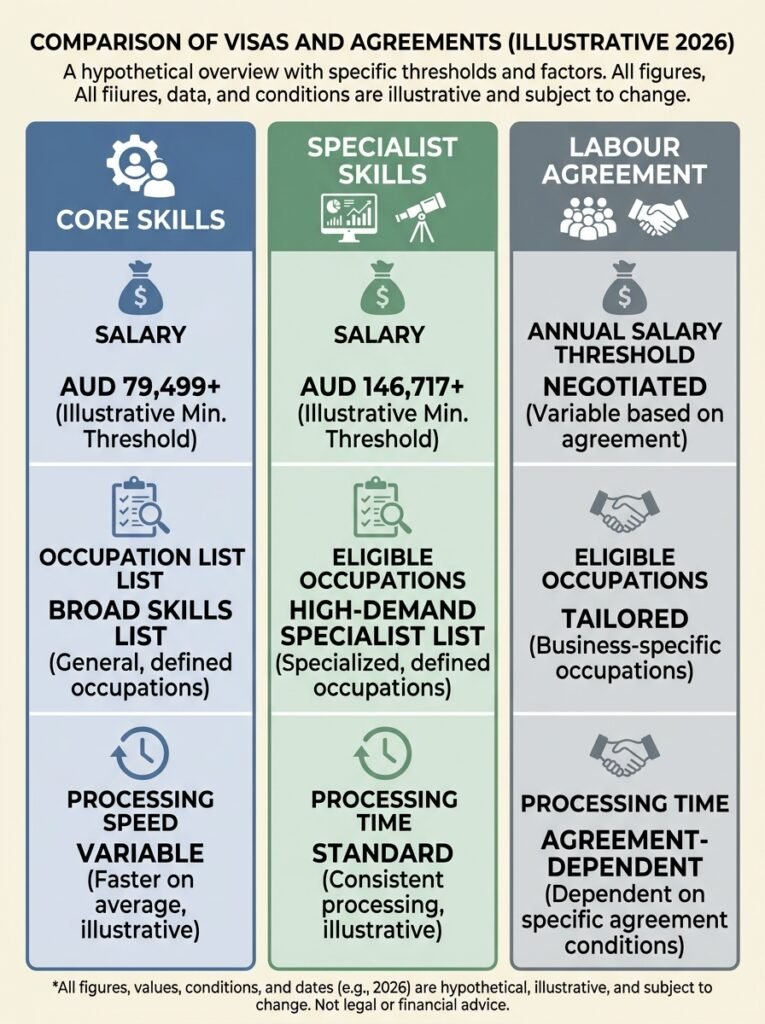
The three streams — and where you fit
The Skills in Demand visa runs on a three-tier system based on your salary and occupation.
1. Core Skills stream. This is the main pathway and the one most applicants use. Your occupation must appear on the Core Skills Occupation List (CSOL), and you must be paid at least the CSIT (AUD 79,499 from 1 July 2026) or the market rate, whichever is higher. Processing typically runs from around one to four months.
2. Specialist Skills stream. For higher earners — from AUD 146,717 (from 1 July 2026) upward. There is no occupation list for this stream, and processing is fast, with a target turnaround of about seven days. It suits senior professionals, executives and specialist tech roles, though trades are excluded.
3. Labour Agreement stream. Used when an employer has a negotiated labour agreement with the government, often in sectors such as aged care or certain regional industries. Salary and occupation rules follow the terms of that specific agreement, and processing tends to be slower.
For most readers, the Core Skills stream is the realistic route — so checking the occupation list is your first practical step.
Is your job on the Core Skills Occupation List?
The Core Skills Occupation List (CSOL) is the single list that decides whether the Core Skills stream is open to you. It was rebuilt for the SID visa using shortage data from Jobs and Skills Australia, and it looks different from the old lists. When the new system launched, more than 70 occupations were added — including roles like data analyst, supply chain analyst, tour guide and childcare worker — while some, such as café or restaurant manager, ICT support engineer and graphic designer, were removed.
Because the list is updated over time, never assume. Check the current CSOL on the Department of Home Affairs website for your exact occupation and its ANZSCO code before you pin your hopes on a job offer.
The rule changes that now work in your favour
The salary rise grabs the headlines, but several SID-era changes actually make life easier for applicants:
- Only one year of experience needed. The old 482 usually required two years of relevant work experience. Under the Skills in Demand visa, one year is generally enough — opening the door to early-career professionals who were previously locked out.
- A 180-day safety net. If you lose your sponsored job, you now have up to 180 days (six months) to find a new sponsor, up from just 60 days under the old rules. During that window you can generally keep working, which takes a lot of pressure off.
- A clearer path to permanent residency. Time on the SID visa counts toward the Employer Nomination Scheme (subclass 186) permanent visa, with eligibility generally opening after about two years of full-time work in your nominated occupation. Note that the 186 salary threshold aligns with the Core Skills figure, so the 1 July rise affects that pathway too.
- Possible English-test exemption for higher earners. Applicants above a set salary level may be exempt from English testing. The exact figure changes, so confirm the current threshold on Home Affairs rather than assuming.
Do bear in mind that 1 July 2026 also brought other routine updates, including higher visa application fees, so budget a little more than last year’s figures.
Who this visa works for — and who it doesn’t
Let’s be honest about fit, because this route is not for everyone.
It suits you if you have a skilled occupation on the CSOL (or you are a high earner for the Specialist stream), at least a year of relevant experience, and — crucially — a real Australian employer willing to sponsor and nominate you at or above the required salary. Skilled trades, healthcare, IT, engineering and similar fields tend to have the strongest chances.
It may not suit you if you do not yet have a sponsoring employer, your occupation is not on the list, or the job on offer cannot meet both the income threshold and the market rate. Remember, this is not a visa you can simply “apply for” alone — the employer’s sponsorship and nomination are the foundation. If your qualification sits outside the skilled lists, other pathways may fit better.
How the application actually works
The process has three separate stages, and the total time depends on all of them:
- Sponsorship. Your employer must be (or become) an approved sponsor — a Standard Business Sponsor — with the Department of Home Affairs.
- Nomination. The employer nominates the specific position for you, showing the occupation is eligible and the salary meets both the income threshold and the market rate. Depending on the stream, they may also need to complete Labour Market Testing to show they tried to hire locally first.
- Visa application. You lodge your visa application, provide your skills, experience, health and character evidence, and meet the English requirement if it applies to you.
Practical tip: use formal, reputable channels to find sponsoring employers — official job boards, company career pages that state visa sponsorship, and licensed recruiters. Tailor your CV to Australian standards and target occupations genuinely in shortage.
A serious scam warning
Sponsorship demand makes this a favourite hunting ground for fraudsters. Protect yourself:
- A genuine employer does not ask you to pay them for a sponsorship or a job offer. Under Australian law, sponsorship and nomination costs are the employer’s responsibility. Being asked to “buy” your nomination is a major red flag.
- No one can guarantee a visa. Anyone promising a “100% guaranteed 482” for a large upfront fee is not to be trusted.
- Be cautious of agents demanding big advance payments over messaging apps, or who will not name the sponsoring company.
- Only take migration advice from a registered migration agent or lawyer, and verify every figure — thresholds, fees, occupation lists — on the Department of Home Affairs website.
Key Takeaways
- The Australia Skills in Demand Visa 2026 (subclass 482) is employer-sponsored — you need a genuine Australian sponsor before you apply.
- From 1 July 2026, the Core Skills threshold is AUD 79,499 and the Specialist Skills threshold is AUD 146,717; you must also be paid at least the market rate.
- Your occupation must be on the Core Skills Occupation List for the main stream — check it before relying on a job offer.
- Applicant-friendly changes: one year of experience, a 180-day window to find a new sponsor, and a clearer path to permanent residency (subclass 186).
- Verify everything on Home Affairs, use official channels, and never pay for a “guaranteed” visa or a job offer.
also read: /poland-seasonal-work-visa-2026-2/
FAQ
Q1. What is the Australia Skills in Demand (482) visa? It is an employer-sponsored temporary work visa that replaced the Temporary Skill Shortage (TSS) visa in December 2024, keeping the subclass 482 number. An approved Australian employer sponsors a skilled overseas worker, usually for up to four years, with a pathway to permanent residency.
Q2. What is the new 482 salary threshold from 1 July 2026? For the Core Skills stream, the minimum rose to AUD 79,499 a year from 1 July 2026. For the Specialist Skills stream it rose to AUD 146,717. You must also be paid at least the Annual Market Salary Rate for the role, whichever is higher.
Q3. How do I know if my occupation qualifies? Your occupation must appear on the Core Skills Occupation List (CSOL) for the main stream. The list was rebuilt for the Skills in Demand visa and is updated over time, so check your exact occupation and its code on the Department of Home Affairs website before applying.