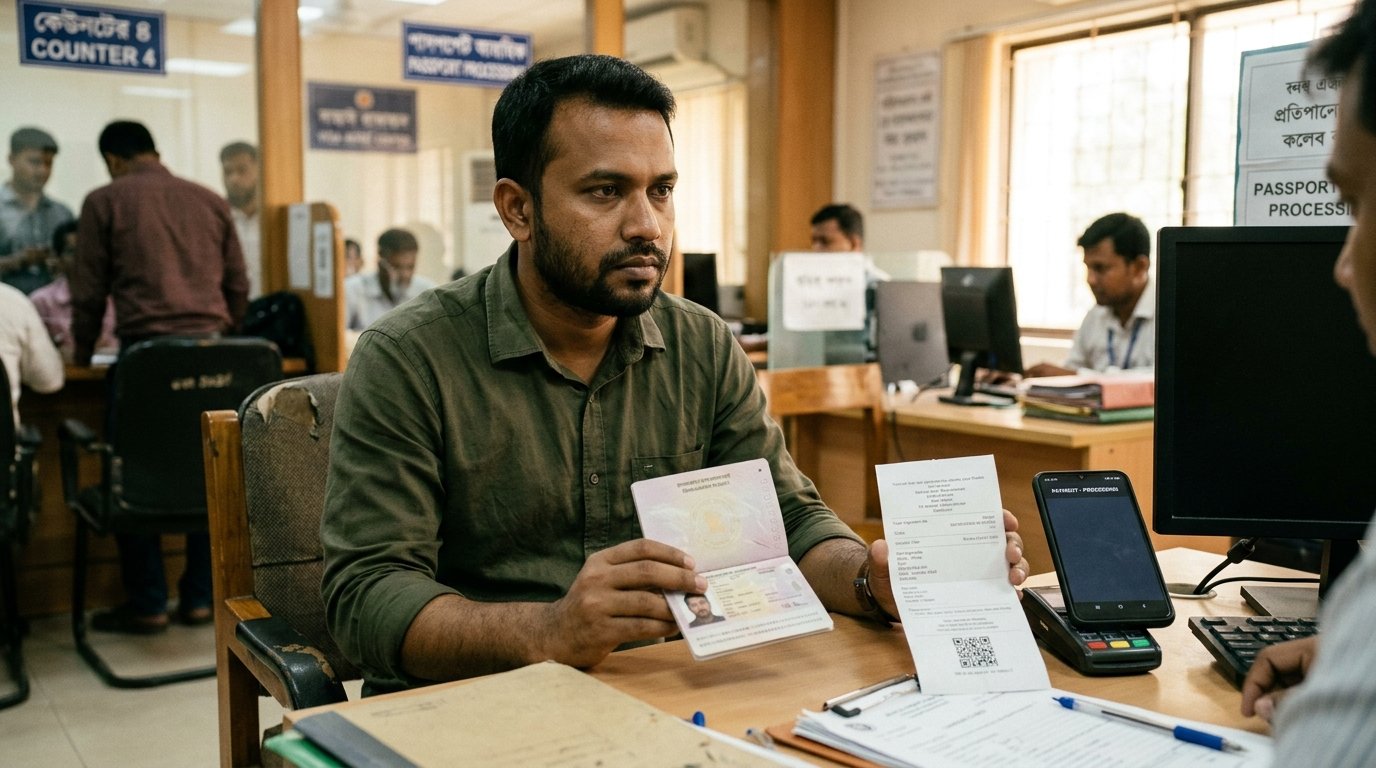
The Protector Fee Is Rs 9,200 — Here’s Every Rupee of It, and Why Your Agent’s Number Is Different
In a manpower office in Gujrat this week, somebody is being told the protector will cost him twenty-five thousand rupees. In Sargodha, somebody else is being told thirty-five. In Karachi, a man is being told it depends on the country, and that Saudi is more expensive than Dubai.
None of those things is true in the way it is being presented. The government charge for protector registration is a fixed amount built from four named line items, and it is the same whether you are flying to Riyadh, Doha, Muscat, Dubai or Bucharest.
That does not mean the men quoting bigger numbers are all lying. It means they are quoting you one number where there are two — the government’s fee, and their own service charge — and hoping you never learn where the line between them sits.
The short answer
The total government protector fee in 2026 is Rs 9,200. It is made up of four charges: Rs 4,000 for the OPF Welfare Fund, Rs 2,500 State Life insurance premium, Rs 2,500 registration fee, and Rs 200 emigration promotion fee. The amount does not change by country, salary or trade.
The official breakdown, line by line
According to the Bureau of Emigration & Overseas Employment, registration for a direct employment visa carries an insurance fee of Rs 2,500, an Overseas Pakistanis Foundation Welfare Fund contribution of Rs 4,000, registration charges of Rs 2,500 and an emigration promotion fee of Rs 200, giving a total of Rs 9,200.
| Line item | Amount | What it is |
|---|---|---|
| OPF Welfare Fund | Rs 4,000 | Makes you a member of the Overseas Pakistanis Foundation |
| State Life insurance premium | Rs 2,500 | Life cover for you while you are abroad |
| Registration fee | Rs 2,500 | The protector registration itself |
| Emigration promotion fee | Rs 200 | Bureau charge |
| Total | Rs 9,200 |
Four numbers. Write them on a piece of paper before you walk into any office.
The authorities have also said that anyone facing allegations of additional charges, or delays, should submit a complaint through the official channels. That sentence exists because overcharging on this specific fee is common enough that the Bureau felt the need to address it.
Why does everyone quote a different protector fee?
Because most people are not quoting the protector fee. They are quoting a bundle.
A recruiting agent’s invoice can legitimately contain several things: his own service charge, GAMCA medical costs, document attestation, translation, courier, travel to the Protectorate office, and the ticket. Some of those are real expenses. But when all of it is compressed into a single sentence — “protector ka thirty thousand lagega” — the fixed Rs 9,200 disappears inside a number you cannot audit.
The test is simple, and you should apply it out loud: ask for the government fee and the service charge as two separate figures, in writing. An honest office will give you both without hesitating. The reaction to that question tells you most of what you need to know.
The second reason for the confusion is that people assume the fee scales with the destination. It does not. A welder going to Saudi Arabia and a driver going to Dubai pay the same registration amount, because the charge is a Pakistani government fee, not a visa cost imposed by the destination country.
What changed in July 2026: the QR payment
For years, the standard explanation for why a worker could not pay his own fee was the bank challan — go to this branch, get this form stamped, come back. That excuse is now considerably weaker.
BE&OE announced on 15 July 2026 that it and the National Bank of Pakistan had launched a QR-based cashless fee payment mechanism to digitise and speed up the emigration process. Reporting on the change notes that fees can now be paid digitally rather than by queueing for a bank challan.
That matters more than it sounds. When the payment is digital and made by you, you have a record of exactly what was paid to the government — which is precisely the document that makes an inflated “protector fee” impossible to defend later.
Who actually needs a protector stamp?
The clearance takes the form of a protector sticker and an embossed signature applied to your passport by a Protector of Emigrants officer at a regional PE office, and it applies to every Pakistani worker going abroad on a work or employment visa regardless of skill level — domestic workers, drivers, labourers, nurses, engineers, IT professionals and managers alike.
You do not need it if you are travelling on a visit, tourist, business, Hajj, Umrah or student visa — only on a work or employment visa.
The most common destinations where it is required are the major Gulf labour markets: Riyadh, Jeddah, Dubai, Abu Dhabi, Doha, Kuwait, Muscat and Bahrain.
This is the point where a certain kind of advice appears: that you can save time by flying out on a visit visa and converting later. BE&OE’s position is that every intending emigrant is legally bound to have his foreign service agreement protected by the concerned Protectorate of Emigrants office. Skipping it does not just risk being stopped at the FIA counter. It removes you from the official record of Pakistani workers abroad — which is exactly the record that gets consulted when something goes wrong.
What Rs 9,200 actually buys you
Most workers think of the protector as an airport formality. It is closer to an insurance policy with a stamp attached.
Life cover. The Bureau introduced a life insurance scheme with State Life Insurance Corporation of Pakistan for intending emigrants back in May 1982, with each emigrant depositing Rs 2,500 as the premium. Published guidance describes that premium as covering the worker’s life for Rs 1,000,000 over five years.
OPF membership. After payment of the welfare fund, the worker becomes a member of the Overseas Pakistanis Foundation, which brings entitlements including educational facilities and school or college admission help for his children, assistance from OPF counters at international airports, access to OPF residential accommodation schemes, the ability to invest through OPF in the industrial sector, and financial help in case of an accident or mishap.
Legal standing. A protected foreign service agreement means full assistance can be sought from the Pakistan mission in the country of employment, and legal assistance from the Community Welfare Attaché at the embassy if the employer violates the agreement.
Read that last one twice if you are heading to the Gulf. The single most common disaster in overseas employment is an employer who does not pay, or who pays less than what was promised. The countersigned agreement is what turns “he promised me” into a document an embassy can act on.
The Migrant Resource Centre describes the purpose of the system as threefold: keeping proper records of Pakistanis working abroad, covering them with life insurance, and curbing illegal recruitment.
How the process runs
Applications are submitted through the official portal at beoe.gov.pk, where documents are uploaded and fees paid, and the process follows four core stages: document submission, registration and briefing, the protector stamp itself, and a final orientation briefing before the stamped passport is returned.
The documents to have ready are your passport carrying the valid work visa, your original CNIC, the employment contract or Foreign Service Agreement signed by your employer, and — for Gulf countries — your GAMCA medical fitness report. If your degree or trade certificates form part of the job requirement, get attestation done first, since many Gulf employers also ask for MOFA attestation or apostille.
One practical note: the pre-departure briefing is not a formality to be skipped or delegated. It is where the rights, complaint channels and emergency contacts are explained. Workers who sit through it properly are measurably harder to exploit later.
The one number you should verify yourself
Be careful with the certainty in this article on a single point.
BE&OE’s own site carries a circular titled as relating to an enhancement in the rate of the insurance premium for protector registration. We could not read the current text of that circular, and the total widely reported in mid-2026 remains Rs 9,200 with the premium at Rs 2,500. Government fee schedules do get revised.
So treat Rs 9,200 as the figure to walk in with and to challenge inflated quotes against — and confirm the current line items on beoe.gov.pk on the day you pay. If the official figure has moved, it will have moved by a few hundred rupees, not by twenty thousand. The gap between the government number and an agent’s number is never explained by a fee revision.
What is coming next
The wider system is being rebuilt, which is worth knowing if you are planning to go abroad in the next couple of years rather than next month.
Pakistan’s National Emigration and Welfare Policy 2026 includes plans for an international call centre for complaints, dedicated special courts for faster dispute resolution, arrangements with local law firms in GCC countries, an EOBI pension scheme, and education vouchers for the children of overseas workers. It also sets out revised rules for Overseas Employment Promoters, a wider role for Community Welfare Attachés, EU Talent Partnerships and digital migration platforms.
Announced policy is not delivered policy, and none of that helps a man boarding a flight next Tuesday. But the direction — digital payment, digital records, faster complaint routes — is consistently away from the paper-and-cash arrangements that made overcharging easy.
Key Takeaways
- The government protector fee in 2026 totals Rs 9,200: Rs 4,000 OPF Welfare Fund, Rs 2,500 insurance, Rs 2,500 registration, Rs 200 emigration promotion.
- The amount is the same for every country — Saudi Arabia, UAE, Qatar, Oman, anywhere.
- Always ask for the government fee and the agent’s service charge as two separate written figures.
- Since 15 July 2026 the fee can be paid digitally through a BE&OE–National Bank QR system, so you can pay and document it yourself.
- Protector is required for every work or employment visa, at every skill level — not for visit, tourist, business, Hajj, Umrah or student visas.
- The fee buys life cover, OPF membership benefits for your family, and a protected employment agreement you can enforce through the embassy.
- Verify the current line items on beoe.gov.pk before paying; fee schedules are occasionally revised.
- If you are asked for more than the official amount as a “government fee”, file a complaint through BE&OE’s official channel.
FAQ
How much is the protector fee in Pakistan in 2026?
Rs 9,200 in total. The Bureau of Emigration & Overseas Employment lists it as Rs 2,500 insurance, Rs 4,000 OPF Welfare Fund, Rs 2,500 registration and Rs 200 emigration promotion fee.
Is the protector fee different for Saudi Arabia and Dubai?
No. It is a Pakistani government registration charge, not a destination-country visa cost, so the same total applies regardless of where you are going or what trade you are in.