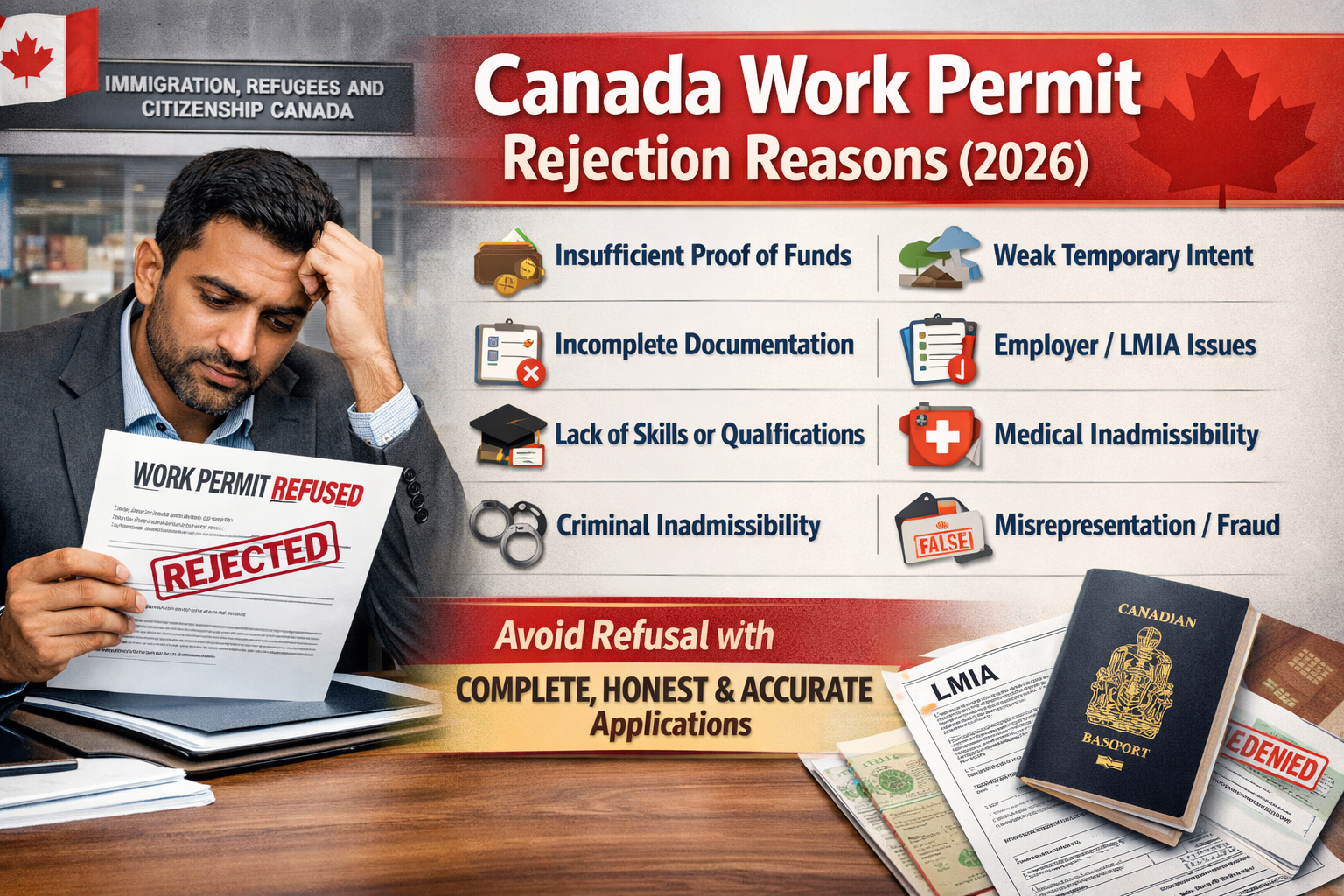
Canada Work Permit Rejection Reasons 2026: Official Causes & How to Avoid Refusal
There are thousands of foreigners who seek a Canadian work permit annually through various immigration programs. Although numerous applications are granted, many are rejected due to certain reasons that might be legal, documents or eligibility reasons.
The refusal of a work permit does not necessarily imply a ban forever. Nonetheless, it does show that the applicant did not meet the legal requirements of the Canadian immigration law as an immigration officer was not convinced of this fact. Knowing the official reasons behind refusal that occur most of the time can improve applicants to make better and more precise applications.
The given guide is an explanation of the primary reasons why work permits in Canada are rejected in 2026, how the visa officers evaluate the applications, and what applicants can do to minimize the chances of being refused.
The Canadian Work Permit Application Assessment
Immigration, Refugees and Citizenship Canada (IRCC) is the main recipient of Canada work permits. The evaluation of applications is done in accordance with the law of the Immigration and Refugee Protection Act (IRPA) and the respective regulations.
Application processing is done by visa officers on the basis of:
- Documentation completeness.
- Eligibility in the particular category of work permit.
- Evidence of employment and compliance by employer.
- Where necessary, Labour Market Impact Assessment (LMIA).
- Financial stability
- Medical admissibility, criminal admissibility.
- Proof of temporary intent
The officers must consider each case on its own. The last one is discretionary although it needs to be consistent with immigration law and program delivery guidelines issued by IRCC.
The majority of Canada Work Permit Rejection Reason
The most common grounds of refusal that are mentioned in official decision letters are listed below.
Insufficient Proof of Funds
Applicants would have to prove that they will be able to sustain themselves (and other family members accompanying them, where they are applicable) throughout their stay in Canada.
Common issues include:
- Bank statements with dissimilar balances.
- Large unexplained deposits
- Uncertainty with regard to finance.
- Lack of adequate finances against family size.
Officers seek financial security, not the short-term increase of the balance before they are submitted.
Poor Evidence of Good Faith Temporary Impressibility
Work permit is a temporary license. Even in the case long-term immigration options are available, the officers should be convinced that the applicant has plans of leaving Canada when his or her authorized stay ends.
Concerns may arise if:
- The candidate does not have strong connections with his or her mother country.
- Employment history is unsound.
- Neither family, property nor business connections are well documented.
- There are preceding overstays in other countries.
Inability to form close relationships may result in rejection regarding the fear of short-term compliance.
Missing or Inaccurate Documentation
Missing or incorrect documents is one of the most popular reasons why the refusal is possible.
Examples include:
- Missing job offer letters
- Improper NOC (National Occupation Classification) code.
- Expired passports
- Incomplete forms
- Missing translations
This was not allowed without evidence to support failure to upload.
Even the smallest mistake may lead to rejection as long as the officer is not able to evaluate eligibility in a proper way.
Employer or LMIA Issues
There are numerous employer-specific work permits that need the positive Labour Market Impact Assessment (LMIA), which are issued by Employment and Social Development Canada (ESDC).
Refusals may occur if:
- The LMIA is not valid or it has expired.
- The position being offered is not LMIA.
- There are compliance violations on the part of the employer.
- The salary provided is lower than regional.
In case the employer does not comply with the requirements of a program, the application of the worker can be denied despite having individual requirements.
Absence of Necessary Skills or Qualifications
The applicants should prove that they satisfy the education, training, or experience requirements of the job.
Issues arise when:
- The letters of work experience are ambiguous.
- Responsibilities are not as per the description of NOC.
- It does not matter what the education credentials are.
- There is no consideration of licensing requirements.
The job description is matched with the background of the applicant by the officers so that there is real suitability.
Medical Inadmissibility
Some candidates have to go through medical examinations. A work permit can be denied in the event of:
- A condition is a threat to the health or safety of a population.
- The condition might lead to overload to the health services.
The medical inadmissibility decisions are in compliance with Canadian health standards under IRPA.
Criminal Inadmissibility
Applicants that harbor some criminal records might be inadmissible.
Refusals may occur due to:
- Severe criminal convictions.
- Lack of guilty plea to previous crimes.
- Pending legal cases
There might be rehabilitation or legal redress, in other cases, but lack of declaration of history can result in further punishment.
Deception or Fraudulent Statements
The ground of misrepresentation is one of the most severe grounds of refusal.
This includes:
- Providing false documents
- Holding back of pertinent information.
- Misstating work history
- Forging counterfeit bank documents.
Misrepresentation can lead to a ban of up to several years of applying in the Canadian immigration programs.
Legal Reasons to say No on Canadian Law
Refusals are made in certain parts of IRPA and its provisions. In the refusal letter, the officer has to mention the reason.
The most popular legal principles entail:
- Inability to pass the officer of eligibility.
- Lack of showing temporary intent.
- Inadmissibility because of health or criminality.
- Misrepresentation
The refusal letter will usually present the concerns of the officer but might not have very detailed descriptions.
Minimising the risk of the refusal of work permits
There are a number of steps that applicants can do in advance:
Make sure that it is well documented
Check all the necessary papers. Adhere to the document checklist of IRCC.
Enhance Financial Result.
Give straightforward and consistent bank statements and clarify on abnormal deposits.
Obviously show Domestic Country Connection.
Provide employment letters, property records, family records or business ownership evidences.
Alignment Work Experience to NOC Duties.
Make sure that work responsibility is in line with the formal job description.
Don’t Misrepresent at All Costs.
Always do not present falsified or missing history.
It is essential that there is accuracy and transparency.
Canada Work Permit Rejection or Refusal
It may not be an ultimate end to your immigration process, even if you are rejected.
Options may include:
- Re-application with better documentation.
- Responding to certain issues mentioned in the refusal letter.
- Consulting counsel in the event of intricate admissibility problems.
- Ask GCMS notes to find out why officers thought this way.
Making a reapplication without rectifying the faults which caused the refusal can end up in another refusal.
Is Canada Refusal of Work Permit Normative?
The rates of refusals differ with respect to:
- Country of residence
- Program category
- Wholeness of application.
- Economic conditions
- Fraud risk trends
There is never a guarantee of approval. Applications are measured separately.
Frequently Asked Questions
-
What are the most common reasons for Canada work permit refusal?
The most popular reasons include insufficient proof of finances, weak temporary attentive, incomplete confirmation, LMIA problems, lack of qualifications, and inadmissibility issues.
-
Does Canada provide reasons for refusal?
Yes. The content letter outlines the officer’s concerns, though statement may be brief.
-
Can I reapply after a work permit refusal?
Yes. You may reapply at any time, supply you address the issues that led to the initial content.
-
Is there an appeal for work permit refusal?
Most impermanent resident refusals do not have a straight appeal process. In controlled circumstances, judicial review through with the Federal Royal court may be possible.
-
How long should I wait before reapplying?
There is no required waiting period, but reapplying instantly without correcting intermission increases the risk of some other refusal.
-
Does refusal affect future applications?
A refusal does not mechanically disqualify future relate. However, previous content must be declared frankly.
Final Thoughts
Canada work permit refusals are supported on legal and indicate standards, not impulsive decisions. Immigration officers assess whether the applicant meets the requirements set under Canadian immigration instrument and whether the application satisfies program criteria.