The $100,000 H-1B Fee Just Lost Again in Court — Here’s What Changes for Job Seekers
For ten months, one number hung over every conversation about American work visas: $100,000. That was the payment the Trump administration attached to certain new H-1B petitions in September 2025, and it was large enough that some employers quietly stopped sponsoring foreign hires altogether. On Friday, July 24, 2026, a federal appeals court refused to bring it back.
Is the $100,000 H-1B fee still in effect?
No. As of July 26, 2026, the $100,000 H-1B fee is not being collected. A federal judge vacated it on June 8, 2026, and on July 24 the First Circuit refused to pause that ruling, so USCIS cannot assess the fee while the government’s appeal continues.
That is the short version. The longer version matters more, because the $100,000 H-1B fee was never the only thing that changed about H-1B sponsorship this year — and if you are planning around a US work visa, the other two changes will affect you for longer than this one did.
How the $100,000 H-1B fee rose and fell: a clean timeline
The policy moved fast, and the reporting around it was messy. Here is the sequence, stripped down.
September 19, 2025. The White House issued a proclamation restricting the entry of certain nonimmigrant workers, attaching a one-time $100,000 payment to specified new H-1B petitions. Before this, total employer-side costs on a typical H-1B filing ran somewhere in the region of $2,000 to $5,000, depending on company size and whether premium processing was used.
September 21, 2025. The requirement took effect for petitions filed on or after this date.
October–December 2025. Legal challenges arrived. The US Chamber of Commerce filed suit in the autumn. On December 12, 2025, a coalition of state attorneys general — 20 states, led by Massachusetts — filed in the US District Court for the District of Massachusetts.
June 8, 2026. District Judge Leo Sorokin vacated the policy, finding it exceeded executive authority and violated the Administrative Procedure Act. His conclusion was blunt: the policy, he wrote, “imposes a tax on H-1B petitions without the requisite delegation by Congress.” Coverage of the decision ran through June 9.
June 12, 2026. The same court partially stayed its own order. In practice this meant the fee kept being collected from June 12 onward while the government appealed — six confusing weeks in which it was simultaneously unlawful and payable.
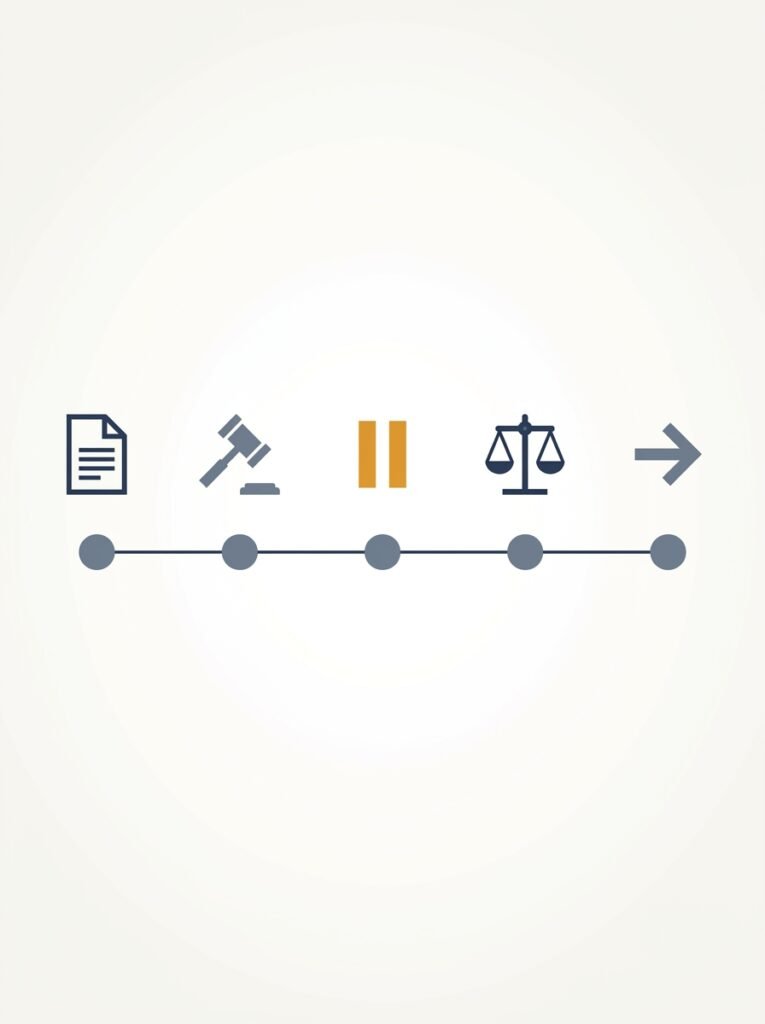
June 18, 2026. The government moved in the First Circuit to keep that stay in place for the duration of the appeal.
July 24, 2026. The First Circuit Court of Appeals in Boston declined. It found the administration unlikely to succeed on the merits, which left the district court’s vacatur standing and ended collection. USCIS is barred from assessing the fee. Wire and secondary coverage carried through July 25.
The appeal itself has not ended. The government can keep litigating the merits before the First Circuit and, if it loses there, can ask the Supreme Court to take the case. What has ended, for now, is collection.
Who actually had to pay the $100,000 H-1B fee — and who never did
This is the single most misunderstood part of the whole episode, and it is worth being precise about, because a lot of people spent ten months worrying about a payment that was never going to touch them.
The fee applied to beneficiaries who were outside the United States without a valid H-1B visa or status at the time of filing, where the petition asked USCIS for consular notification, port-of-entry notification, or pre-flight inspection. In plain terms: new hires who would have to collect a visa at a US consulate abroad before entering. It could also be triggered indirectly — if a change-of-status or extension request was denied and the worker consequently had to obtain H-1B status from outside the country.
The fee did not apply to:
- People who already held H-1B visas or H-1B status.
- Petitions filed before September 21, 2025.
- Change of status, extension, or amendment petitions that USCIS approved for people already physically present in the United States — the pathway most F-1 students on OPT use when they move to H-1B after graduation. The approval matters: if such a request was denied and the person then had to obtain H-1B status abroad, the payment could attach after all.
- Beneficiaries getting a visa stamp abroad after a US-filed petition was approved.
There was also a national interest exception route, with the Department of Homeland Security able to waive the payment where an individual’s presence served the national interest, no US worker was available, and the payment would meaningfully undermine American interests.
So the practical burden landed hardest on one group: the person hired from abroad who had never been to the US in H-1B status. If that is you, the July 24 order is the news of your year.
What the ruling changes for you right now
If you are outside the US waiting on a consular H-1B. The economics of hiring you just improved by up to $100,000. Employers who paused or withdrew sponsorship on cost grounds — disproportionately startups, small firms and mid-size employers who could never absorb the payment — have a reason to revisit. It is a fair, non-desperate thing to email a recruiter who went quiet in late 2025 and ask whether the position is being reconsidered now that the fee has been struck down. Reference the date; it signals you follow the file.
If you are in the US on F-1, OPT or another status. Very little changes, because you were most likely exempt the whole time. Your real variables are the lottery and your employer’s compliance posture, both covered below.
If your employer already paid. This is unresolved. There is no confirmed refund mechanism for the $100,000 H-1B fee as of July 26, 2026, and USCIS had not published updated filing guidance at the time of writing. The sensible move is documentary: keep every receipt, filing record and payment confirmation, and let counsel monitor whether a refund process emerges from the litigation. Do not assume money is coming back, and do not assume it is not.
If you are mid-filing this week. Expect a short window of procedural confusion while USCIS updates its instructions. Petitions filed during a gap in official guidance are the ones most likely to draw a request for evidence, so this is a period for careful paperwork rather than speed.
Four things the ruling does not mean
Court news travels faster than court reasoning, and a lot of what circulated over the weekend was wrong. Four corrections worth internalising before you make plans on this.
It does not mean H-1B sponsorship is now cheap or easy. Removing the $100,000 H-1B fee restores the previous cost structure rather than creating a new incentive. The ordinary filing costs — base petition fee, the training and fraud-prevention surcharges, attorney fees, and premium processing where used — are unchanged and still land in the low thousands of dollars per case.
It does not mean the policy has been permanently defeated. The First Circuit refused a stay, which is a prediction about the likely outcome, not the outcome. The merits appeal is still pending, and a Supreme Court petition is available to the losing side. Anyone telling you the matter is settled is guessing.
It does not create a new visa, a new quota, or a new route. The annual cap remains 65,000 plus 20,000 for US advanced-degree holders. The FY 2027 allocation is already gone, confirmed on July 17, 2026, with no second selection round. The next entry point is FY 2028 registration in early 2027.
It does not change anything for people already holding H-1B status. They were exempt from the payment throughout. Extensions, amendments and transfers inside the United States were never within its scope.
The bigger picture: three forces reshaping H-1B sponsorship in 2026
The fee got the headlines. It was not the most consequential change. Read these three together and you get an accurate map of what sponsorship looks like heading into next year.
1. The lottery is now weighted by salary
A Department of Homeland Security final rule effective February 27, 2026 replaced the flat random lottery with a wage-weighted selection. Registrations now receive between one and four entries depending on where the offered salary sits against the Occupational Employment and Wage Statistics wage levels for that role and location — Level I gets one entry, Level II gets two, Level III three, Level IV four.
The structural effect is straightforward and permanent-feeling: an entry-level offer is now competing at a quarter of the weight of a senior one. For candidates, salary negotiation is no longer only about income. It is about selection odds.
2. Registration volume collapsed
For FY 2027, USCIS received 211,600 eligible registrations — down roughly 38.5% from the 343,981 submitted for FY 2026. On July 17, 2026, the agency announced it had received enough petitions to hit both the regular 65,000 cap and the 20,000 US advanced-degree exemption, and confirmed there would be no second selection round.
That drop is the fee’s real legacy. It did not primarily filter applicants; it deterred employers from entering the pool at all. Whether volume rebounds for FY 2028 — registration opens around March 2027 — is now the open question, and the July 24 ruling makes a rebound more likely.
3. Enforcement got serious
The Department of Labor launched Project Firewall on September 19, 2025, an initiative under which the Labor Secretary personally certifies investigations where there is reasonable cause to suspect H-1B violations. By November 2025 the department had reported at least 175 investigations underway, and no updated count has been published since — treat that figure as a floor rather than a total.
On July 8, 2026, the DOL’s Office of Inspector General escalated sharply, announcing a major inquiry spanning alleged H-1B and PERM abuse, labour trafficking and the displacement of American workers, coordinated with the Department of Homeland Security and the Justice Department. Inspector General Anthony D’Esposito said investigators had already begun issuing dozens of subpoenas to companies and labour brokers. Reporting has connected at least one large IT services employer to the inquiry; no charges have been filed against any company named.
For workers, this cuts both ways. Enforcement targets wage underpayment, US-worker displacement, false labor condition applications and misrepresented worksites — abuses that hurt H-1B employees directly. Workers retain the right to the prevailing wage and can report violations to the DOL Wage and Hour Division. But investigations also slow filings, and a sponsor under audit is a slower sponsor.
What this means for the FY 2028 cap season
Registration for FY 2028 is expected around March 2027. Planning from where we sit today:
- Assume no $100,000 H-1B fee, but do not bank on it. The merits appeal is live and could reach the Supreme Court. Build your plan for the world without the fee; keep a contingency for the world with it.
- Push your offered wage level as high as the role honestly supports. Under weighted selection this is the highest-leverage variable you control. A Level III offer is three times as likely to be drawn as a Level I.
- Ask your prospective employer directly about compliance history. In a Project Firewall environment, a sponsor with clean labor condition applications and audit-ready records is worth more to you than one offering slightly more money.
- Watch registration volume. If employers who sat out FY 2027 return, the 38.5% drop reverses and selection odds tighten again. Last year’s low volume was an artefact, not a trend.
If the H-1B route stays closed to you, what else is realistic
Not every plan survives the lottery. A few paths that do not depend on it:
Cap-exempt employers. Universities and their affiliated nonprofits, nonprofit research organizations, and government research organizations can file H-1B petitions year-round with no lottery at all. This is the most underused route on the list, and it is not limited to academics — universities and teaching hospitals employ IT staff, analysts, accountants and administrators.
Country-specific programs. If you are targeting Europe rather than the US, the structural picture is different and often more accessible for mid-skill trades and seasonal work.
Employer-sponsored permanent routes. For candidates already in the US in another status, an employer willing to start a permanent labour certification process is a slower but lottery-free path. It is a multi-year commitment on both sides.
A caution worth stating plainly: periods of visa turbulence are exactly when fraudulent agents surface, promising guaranteed sponsorship, guaranteed selection or paid “reserved” slots. None of those exist. Selection is a government process; nobody can sell you a place in it. If an agent’s pitch depends on a policy change they cannot cite by date and source, treat the pitch as the product.
Dates to watch over the next twelve months
The situation is live, and a handful of specific moments will determine what the next cap season looks like. Marking these is more useful than following daily commentary.
Late July to August 2026. Updated USCIS filing guidance and revised petition instructions reflecting the halt in collection. This is the document that will tell employers, in operational terms, what to do with pending and recently filed cases — and whether anything is said about money already paid.
Autumn 2026. Briefing and argument on the merits before the First Circuit. A decision here, rather than the stay ruling, is the one that determines whether the policy is finished.
Late 2026 to early 2027. Any petition for Supreme Court review by the losing side, plus whatever the Department of Labor’s inspector general inquiry produces. Enforcement outcomes shape which employers are willing to sponsor at all.
Around March 2027. FY 2028 registration opens. Watch the announced registration total closely: if it climbs back toward the 343,981 recorded for FY 2026, the deterrent effect has washed out and selection odds tighten accordingly. If it stays near the 211,600 of FY 2027, a materially better-than-historical chance persists for anyone who does register — particularly at higher wage levels.
The honest summary for anyone planning a US move: the single largest cost obstacle of the past year has been removed, the odds structure has shifted toward experienced and better-paid candidates, and enforcement has tightened around sponsors. That is a more navigable landscape than it was in October 2025, but it rewards preparation over speed.
Key Takeaways
- The $100,000 H-1B fee is not being collected. A district judge vacated it on June 8, 2026; the First Circuit refused to stay that ruling on July 24, 2026.
- The government’s appeal on the merits continues and could ultimately reach the Supreme Court, so the outcome is not final.
- The fee only ever applied to new petitions for beneficiaries abroad requiring consular processing. Change of status, extensions and amendments inside the US — including the F-1 to H-1B route — were exempt.
- There is no confirmed refund process for employers who already paid. Keep records.
- Two changes matter more long-term: the wage-weighted lottery effective February 27, 2026, and the DOL’s Project Firewall enforcement wave.
- FY 2027 registrations fell to 211,600, down about 38.5% year on year. The cap was reached on July 17, 2026, with no second lottery.
FAQ
Q: Is the $100,000 H-1B fee still being charged in 2026? A: No. The fee was vacated by a federal district court on June 8, 2026, and on July 24, 2026 the First Circuit Court of Appeals declined to pause that ruling. USCIS is barred from assessing it while the appeal proceeds.
Q: Who had to pay the $100,000 H-1B fee? A: It applied to new H-1B petitions filed on or after September 21, 2025 for beneficiaries outside the United States who needed consular processing, port-of-entry notification or pre-flight inspection before entering in H-1B status.
Q: Did the $100,000 fee apply to F-1 students changing status to H-1B? A: No. Petitions filed as a change of status, extension or amendment for someone already physically present in the United States were exempt, which covers the standard F-1 or OPT to H-1B pathway when status is maintained and the petition is approved.