
Chevening Scholarship 2027: Your Prep Plan Before Applications Open in August
If a fully funded master’s degree in the UK is on your radar, the Chevening Scholarship 2027 is the one to plan around now. Funded by the UK Government, Chevening covers your tuition, living costs, and flights for a one-year master’s — and the 2027/28 cycle is expected to open for applications in August 2026, with a deadline anticipated around 7 October 2026. That means right now is the preparation window, not the application window, and that distinction is exactly why most people miss out.
The applicants who succeed are almost never the ones who start writing on the day the portal opens. They are the ones who used the weeks beforehand to shortlist courses, brief their referees, and draft their essays. This guide gives you that head start — the eligibility rules, what Chevening pays for, and a concrete plan for what to do before the portal goes live.
Quick answer: The Chevening Scholarship 2027 is a fully funded UK Government award covering a one-year master’s degree — including tuition, a monthly stipend, and return airfare. Applications for the 2027/28 cycle are expected to open in August 2026 and close around 7 October 2026. You apply online at chevening.org; dates are not yet officially confirmed, so verify on the official site.
What the Chevening Scholarship actually is
Chevening is the UK Government’s flagship international scholarship programme, run by the Foreign, Commonwealth & Development Office (FCDO) together with partner organisations. It has operated since 1983 and built an alumni network of well over 55,000 professionals across more than 160 countries. Each year it awards roughly 1,500 scholarships worldwide, making it one of the largest fully funded master’s programmes anywhere.
The core offer is simple and generous: one year of postgraduate study at a UK university of your choice, with the major costs covered so you can focus on the degree and the network rather than the bills.
What Chevening covers
Chevening is designed to cover the essential costs of studying and living in the UK for your master’s year — not luxuries, but genuinely enough to study without financial stress. Based on the programme’s published benefits, a Chevening award typically includes: full university tuition fees; a monthly living stipend; return economy airfare to and from the UK; an arrival allowance; a homeward departure allowance; the cost of one UK visa application; and a travel grant to attend Chevening events in the UK.
It’s structured so you can live comfortably within a budget, but you’re still expected to manage your own expenses sensibly. Confirm the exact current benefits on chevening.org, since programme details can be updated between cycles.
Who is eligible for Chevening 2027
Chevening’s eligibility rules are firm, and checking them honestly now saves you from wasting an application. To apply, you generally must:
- Be a citizen of a Chevening-eligible country or territory. Pakistan and most South Asian countries are eligible — confirm your specific country on the official list. British and dual-British citizens are generally not eligible except in limited cases.
- Hold an undergraduate degree that qualifies you for a UK postgraduate programme (typically equivalent to a UK upper second-class, or 2:1, honours degree).
- Have at least 2,800 hours of work experience — roughly two years — which can include full-time, part-time, voluntary, or internship work.
- Apply to three eligible UK master’s courses and, if selected, hold an unconditional offer from at least one of them by Chevening’s stated offer deadline.
- Agree to return to your home country for at least two years after the scholarship ends.
- Demonstrate leadership potential and a clear plan to create positive impact back home.
If you tick these boxes, you’re a genuine candidate. If you fall short on the work-experience hours or the degree level, it’s usually better to strengthen your profile and apply in a later cycle than to submit a weak application now.
Key dates for the 2027 cycle (expected)
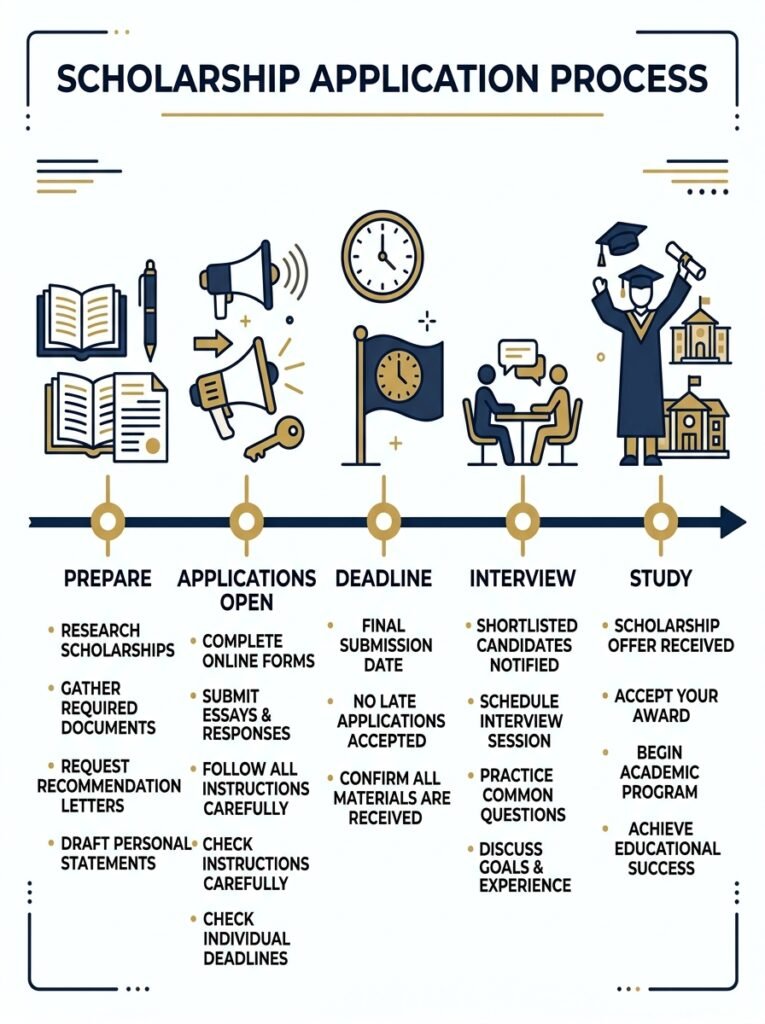
Chevening runs on a predictable annual rhythm, and the 2027/28 timeline is expected to follow it: applications opening in August 2026 and closing at around 7 October 2026, 12:00 midday UK time. After the deadline come reading and shortlisting, interviews in early 2027, university-offer deadlines in mid-2027, and studies beginning in September/October 2027.
One important caveat: as of now, the official 2027/28 dates have not been formally confirmed by Chevening. Treat the dates above as the anticipated schedule, bookmark chevening.org, and set a reminder for late July 2026 to check the confirmed opening date.
Your preparation playbook — what to do before the portal opens
This is where you win or lose Chevening, and it happens before you ever log in. Use the pre-opening window like this.
1. Confirm eligibility and shortlist your three courses. Choose based on genuine academic fit and your career plan, not prestige alone. A well-argued choice of a specialist programme often impresses selectors more than a reflexive “Oxford or Cambridge” pick. Read entry requirements carefully so your three choices are realistic.
2. Line up your two referees early. You’ll need referees who can speak credibly to your leadership and professional impact. Give them at least eight weeks’ notice and brief them properly on what Chevening values, so their input is specific rather than generic.
3. Draft the four essays now. Chevening’s application centres on four questions covering leadership, networking, your choice of course/university, and your career plan. Draft them during the prep window so you can refine rather than rush. Use the STAR method — Situation, Task, Action, Result — for every example, and make sure your essays don’t contradict each other; inconsistency across answers is a quiet application-killer.
4. Gather your documents. Academic transcripts, degree certificates, proof of work experience, passport, and your university research all take time. Assembling them now means the application itself becomes data entry, not a scramble.
5. Understand English-language proof. Chevening’s language requirement is usually satisfied through your university offer rather than a separate test in the application stage, but requirements vary by course — check each university’s rules.
The four essays, briefly
Think of the four essays as one coherent story. The leadership essay should show real influence, not just a job title. The networking essay is about how you build and use relationships to get things done. The course choice essay must connect your three UK programmes logically to your goals. And the career plan essay should make your two-year return commitment feel purposeful — what you’ll build at home with a UK master’s behind you. Selectors reward clarity and consistency far more than grand language.
Common reasons strong candidates get rejected
Even qualified applicants trip over avoidable mistakes: starting the essays after the portal opens and running out of time; choosing universities by ranking instead of fit; writing vague leadership claims with no measurable result; contradicting themselves across the four essays; and briefing referees too late or too little. Almost every one of these is fixed by preparing early — which is the whole point of acting now.
Who should think twice before applying
- Those below the 2,800-hour work-experience threshold — build experience first.
- Anyone unwilling to return home for two years, which is a binding commitment, not a formality.
- Applicants who can’t commit real time to the four essays — a rushed Chevening application rarely succeeds.
- People chasing prestige over fit — the programme rewards a clear, honest career narrative.
If that’s you right now, a stronger route may be to prepare for the next cycle or apply to complementary awards.
Chevening isn’t your only option
While you prepare, consider running parallel applications. GREAT Scholarships from the British Council offer partial-to-full funding at specific UK universities for students from eligible countries including Pakistan, India, Bangladesh, and Nigeria, and they run on their own separate cycles. Applying to more than one scholarship is smart — it widens your options and forces you to sharpen your personal statement across applications.
Key Takeaways
- The Chevening Scholarship 2027 is a fully funded UK Government master’s award — tuition, stipend, and flights covered.
- The 2027/28 cycle is expected to open in August 2026 and close around 7 October 2026 — confirm on chevening.org.
- Core eligibility: eligible-country citizen, undergraduate degree, 2,800 hours work experience, three UK course choices, and a two-year return commitment.
- Prepare before the portal opens: shortlist courses, brief referees eight weeks early, and draft the four essays using STAR.
- Consider GREAT Scholarships as a parallel option, and always verify dates and rules on the official site.
FAQ
Q1: When does the Chevening Scholarship 2027 open? The 2027/28 cycle is expected to open for applications in August 2026, following Chevening’s usual annual pattern, with an anticipated deadline around 7 October 2026. Official dates are not yet confirmed, so check chevening.org in late July 2026.
Q2: What does the Chevening Scholarship cover? It covers full university tuition, a monthly living stipend, return economy airfare to and from the UK, an arrival allowance, a homeward departure allowance, the cost of one UK visa application, and a travel grant for Chevening events.
Q3: Am I eligible for Chevening as a Pakistani applicant? Pakistan is a Chevening-eligible country. You generally need an undergraduate degree, at least 2,800 hours (about two years) of work experience, three eligible UK master’s course choices, and a commitment to return home for two years. Confirm the current criteria on the official list.