Saudi Arabia’s Skill Test Now Blocks Work Visas in 2026 — Here’s What Pakistani Workers Must Know
If you’re a skilled worker planning to move to Saudi Arabia, there’s now one exam standing between you and your work visa — and in 2026, it is no longer optional. The Saudi skill verification test (the Skill Verification Program, or SVP) has become a hard requirement: for listed trades, no valid certificate means no work visa, and no residency (iqama) renewal either.
For Pakistani workers especially, this matters more than almost anywhere else — Pakistan was the very first country where Saudi Arabia rolled this out. Here’s exactly what the test is, which trades need it, what it costs, and how to register the right way without getting scammed.
What is the Saudi skill verification test? The Skill Verification Program (SVP) is a mandatory trade exam that skilled workers must pass before a Saudi work visa is issued. In 2026 it’s strictly enforced through the Qiwa platform — work visas and iqama renewals for listed trades are digitally blocked without a valid certificate. It costs about $50, and the certificate is valid for five years.
What the SVP actually is
The Skill Verification Program was launched on 1 July 2021 by Saudi Arabia’s Ministry of Human Resources and Social Development (MHRSD) to make sure foreign workers in technical trades genuinely have the hands-on skills their job title claims. Pakistan was the first country to implement it, and it has since expanded to India, Sri Lanka, Egypt, and others.
In Pakistan, the testing is delivered by Takamol (the Saudi operator) in partnership with the National Vocational and Technical Training Commission (NAVTTC), through approved assessment centres.
What changed in 2026 (the important part)
For a few years the SVP felt like optional paperwork. That’s over. In 2026, the program moved to strict digital enforcement through Saudi Arabia’s Qiwa platform. In practice:
- New work visas in listed professions won’t be issued until you’ve passed the exam and hold a valid certificate.
- Iqama (residency) renewals for those same professions are now digitally checked against a valid certificate — an expired or missing certificate can block your renewal.
There are two tracks. The external track tests new recruits in their home country (Pakistan, India, Bangladesh, Sri Lanka and others) before the work visa is issued. The internal track verifies workers already inside Saudi Arabia, usually triggered by a permit renewal or a change of profession. Most people reading this will be on the external track.
Which trades need the skill verification test?
The program started with five core vocational trades, and Saudi Arabia has been adding more in later phases. The first-phase trades commonly include:
- Plumber
- Electrician
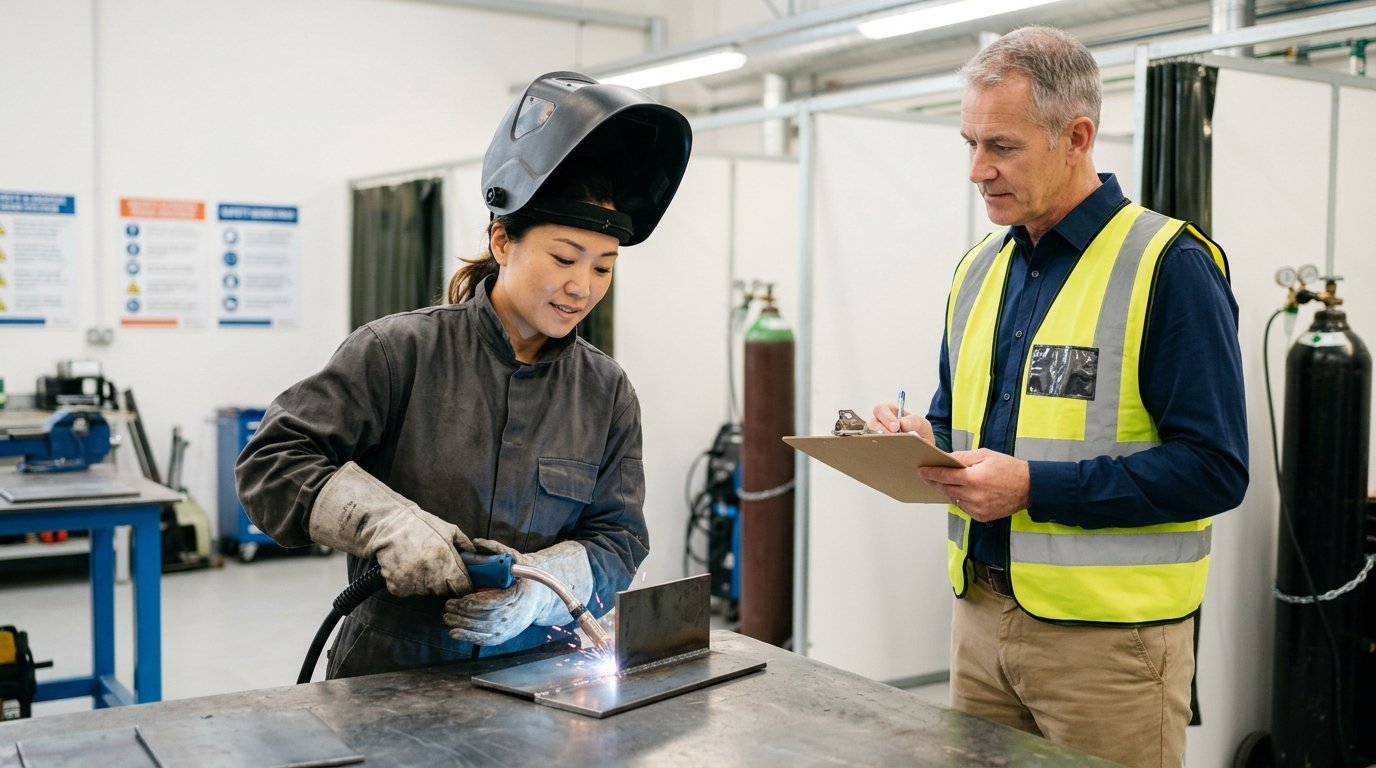
- Welder
- Refrigeration / air-conditioning (AC) technician
- Automobile electrician / mechanic
Additional technical and construction trades have been folded in over time, so the current list is longer than the original five. Because the list keeps expanding, check the official SVP/Qiwa portal for your exact profession before assuming you’re in or out.
SVP vs SCE: don’t take the wrong path
This trips up a lot of people. The SVP is for skilled and vocational trades (electricians, welders, technicians, and so on). Engineers are different — they generally go through the Saudi Council of Engineers (SCE) Professional Accreditation process, not the SVP. Sending an engineer through the SVP (or a tradesperson through SCE) wastes weeks and can get an application rejected. Match your real job title to the correct route before you book anything.
The exam: format, pass mark, and attempts
The skill verification test is a two-part assessment:
- Theory — a computer-based test of roughly 30 minutes.
- Practical — a hands-on assessment of about 90 to 120 minutes.
Other key rules to know:
- Pass mark: 50%, combining theory and practical.
- Languages: you can typically sit it in Urdu (and other South Asian languages), not only Arabic or English.
- Results: published within about 24 hours on the official portal, with a downloadable digital certificate if you pass.
- Validity: the certificate is valid for five years, which covers renewals within that window.
- Attempts: you generally get a maximum of three attempts. Fail all three from abroad and you can lose the visa route for that profession; workers already inside Saudi Arabia risk losing their permit. Leave a couple of weeks to prepare between attempts and use your result breakdown to target weak areas.
What it costs
As of early 2026, the fee has been reported at around $50 (roughly Rs 14,100), paid once, typically covering registration, the exam, and the certificate. Fees can be revised, so confirm the current amount on the official portal before paying — and never pay a “premium” to a middleman claiming to speed things up.
How to register (step by step)
- Confirm your trade is listed and that SVP (not SCE) is your correct route.
- Create an account on the official SVP portal (the Takamol/PACC SVP international registration page).
- Complete your profile with accurate personal and professional details (CNIC, passport, contact info).
- Select your trade, assessment centre, and test date. In Pakistan, centres operate in Karachi, Lahore, and Islamabad.
- Pay the official fee (challan) and download your roll-number slip.
- Attend the test on the scheduled date at the chosen centre.
- Check your result (about 24 hours later) and download your digital certificate from the portal once you pass.
How to prepare and pass
Treat it like the real trade exam it is. Revise the core theory of your trade, practise the practical tasks you’ll be judged on (safety, correct technique, tools), and don’t wing the hands-on portion — that’s where many candidates lose marks. If your spoken/reading language is Urdu, register in Urdu so language isn’t an extra barrier. Passing first time saves money and, more importantly, avoids delaying your visa.
Avoid scams (read this carefully)
High demand plus a hard requirement is a magnet for fraud. Protect yourself:
- Register only through the official SVP/NAVTTC/Takamol portal. Verify centres and fees there.
- The fee is modest and one-time. If an agent demands large sums to “arrange,” “guarantee,” or “fast-track” your certificate, walk away.
- No one can guarantee a pass. It’s a real skills test — certificates can’t legitimately be bought.
- A fake certificate will not survive Qiwa’s digital checks and can blacklist you. Don’t risk it.
- For your rights on wages, hours, and overtime in Saudi Arabia, rely on Pakistan’s Bureau of Emigration & Overseas Employment (BE&OE) and official channels — not informal agents.
Who is affected — and who isn’t
If your profession is on the SVP list and you want a Saudi work visa (or need to renew your iqama in that profession), the test applies to you. Engineers follow the SCE route instead. Professions not on the list may not require the SVP at all right now — but since the list is expanding, verify your specific trade before assuming you’re exempt.
Key Takeaways
- The Saudi skill verification test (SVP) is mandatory in 2026 — no valid certificate means no work visa and no iqama renewal for listed trades.
- It applies via the external track for new recruits tested in Pakistan (centres in Karachi, Lahore, Islamabad) through Takamol + NAVTTC.
- Core trades include plumber, electrician, welder, AC technician, and auto mechanic — but the list keeps growing, so check the official portal.
- The exam is theory + practical, pass mark 50%, fee about $50, certificate valid 5 years, 3 attempts max.
- Engineers use SCE, not SVP. Register only through official channels and beware “guaranteed pass” scams.
FAQ
Q1: Is the Saudi skill verification test mandatory? Yes, for listed trades. As of 2026, Saudi Arabia enforces the SVP through the Qiwa platform, so work visas and iqama renewals in covered professions are blocked without a valid certificate. Professions not on the list may not require it, but the list keeps expanding.
Q2: Which trades need the Saudi skill verification test? The program began with plumber, electrician, welder, refrigeration/AC technician, and automobile electrician/mechanic, and more technical and construction trades have been added in later phases. Check the official SVP portal for your exact profession.
Q3: How much does the SVP test cost? As of early 2026, the fee has been reported at about $50 (roughly Rs 14,100), paid once, typically covering registration, the exam, and the certificate. Confirm the current fee on the official portal and never pay large sums to middlemen.