
Germany Opportunity Card 2026: How to Move There Without a Job Offer
Germany Opportunity Card 2026 is the one immigration route that flips the usual rule on its head: you can move to Germany first and look for a job after you arrive, instead of needing an employer to hire you before you ever land. Known in German as the Chancenkarte, this residence permit gives qualified non-EU professionals up to 12 months on the ground to search for skilled work, attend interviews, and even earn money part-time. If you have been chasing employer sponsorship with no luck, this is the page worth reading slowly.
Below is a clear, current breakdown of who qualifies in 2026, how the points system works, what it costs, and the honest pitfalls most “guaranteed visa” pages leave out.
What is the Germany Opportunity Card (Chancenkarte)?
The Opportunity Card is a job-seeker residence permit created under Section 20a of Germany’s Residence Act (Aufenthaltsgesetz), and it has been in force since 1 June 2024 according to legal guides tracking the law. Its whole purpose is to let skilled people from outside the EU and EEA enter Germany to look for qualified employment — without already holding a contract.
That single feature is what makes it different from the EU Blue Card or a standard work visa. As immigration analysts describe it, the Blue Card and most work visas are employment-based (you need the offer first), while the Chancenkarte is a search-based card built for people who are qualified but not yet hired. One legal commentary called it a shift from employer-driven to candidate-driven migration into Europe’s largest economy.
The card is issued for a maximum of 12 months. During that year you are allowed to work part-time and to trial jobs with employers, which we cover below.
Also Read: Germany Work Permit guide
Why the Opportunity Card matters in 2026
Germany has a well-documented shortage of skilled labour across healthcare, engineering, IT, logistics and the trades. The Opportunity Card is part of Germany’s strategy to pull in qualified talent faster, and 2026 guidance from multiple immigration sources confirms the core rules are now settled and operating, with refreshed financial and wage figures for the year.
For readers already exploring German roles — from caregiving to warehouse and driving jobs — the Opportunity Card can be the entry door that lets you job-hunt locally, where employers are far more willing to interview someone who is already in the country.
Also Read: Germany Caregiver Jobs with Work Visa 2026
Two ways to qualify in 2026
There are two separate routes, and you only need to satisfy one of them.
Route 1 — Recognised skilled worker (no points test). If your foreign university degree or vocational qualification is fully recognised in Germany, you qualify directly as a skilled worker and skip the points system entirely. You still have to meet the basic financial and document requirements.
Route 2 — The points system (minimum 6 points). If your qualification is not fully recognised, you can still qualify by scoring at least six points on the official Chancenkarte grid, as long as you meet the baseline language and financial requirements. This route is what opened the door for thousands of applicants whose credentials were not automatically accepted.
A key eligibility detail people miss: even for the points route, you generally need either a university degree or a vocational qualification of at least two years recognised in your country of origin.
How the points system works
You collect points across several categories, and you need a minimum of six. Based on current 2026 guidance from German-focused advisory sites, the scoring rewards factors like:
- Qualification — partial recognition, or training in an occupation Germany is short on.
- Work experience — relevant professional experience adds points.
- Age — younger applicants score more: roughly 2 points for those up to age 35, and 1 point for ages 35–40.
- Language — German is the big lever. Higher German levels earn more (for example, B1 and B2+ German score progressively more points), while English B2 satisfies the baseline but adds little on its own.
- Prior ties to Germany — earlier legal residence in Germany can count.
- Spouse / partner — a joint application where your partner also qualifies can add a point each.
To see a realistic picture: advisory sites use an illustrative profile of an Indian IT professional, age 28, with a bachelor’s degree, English at B2, and three years of experience — that mix lands comfortably above the six-point threshold. Treat that as an example, not a promise; your own score depends on your exact documents.
Honesty note: point values per category can be described slightly differently across sources. Before you bank on a number, run the official Self-Check tool on the “Make it in Germany” portal, which is the authoritative calculator.
The financial requirement for 2026
You must prove you can support yourself while you job-hunt. For 2026, the figure quoted across official-facing guides is at least €1,091 net per month, which works out to about €13,092 per year.
You can usually prove this through one of:
- A blocked account (Sperrkonto) holding roughly €13,092.
- A formal declaration of commitment from a sponsor in Germany.
- A qualifying part-time job contract in Germany, depending on the salary.

Here is a useful 2026 detail: Germany’s minimum wage rose to €13.90 per hour from 1 January 2026. At the permitted 20 hours a week, that adds up to roughly €1,112 a month — slightly above the self-sufficiency threshold — which is why a part-time contract can sometimes satisfy the financial test.
Language requirement
The baseline is A1 German OR B2 English. German is not strictly mandatory if you meet the rest of the criteria. But be realistic: advisory sources repeatedly stress that the jobs genuinely open to A1-only, English-speaking candidates are limited, and German is also the easiest way to push your points total up. If you are serious about staying, start learning German early.
What you are allowed to do on the card
While you hold the Opportunity Card, you can:
- Work part-time up to 20 hours per week in any sector — useful for covering living costs.
- Take trial employment (Probebeschäftigung) of up to two weeks per employer, with no cap on how many trials you do. This lets you test multiple workplaces before committing.
What you cannot do is treat it as a full work permit. The 20-hour cap stays in force until you secure a qualifying role and convert your status.
Documents you will typically need
Exact lists vary by consulate, but expect to provide:
- A valid passport.
- Proof of your degree or vocational qualification, plus recognition evidence.
- Proof of funds (blocked account statement, sponsor declaration, or part-time contract).
- Language certificate (German A1 or English B2).
- Completed application form and biometric photos.
For credential recognition, academic degrees are checked through the Anabin database (maintained by the KMK); your qualification generally needs an Entspricht or Gleichwertig rating and the issuing institution should carry an H+ rating. Vocational qualifications are assessed by the ZAB or via anerkennung-in-deutschland.de. Check your recognition before you book any flights.
How to apply for the Germany Opportunity Card 2026
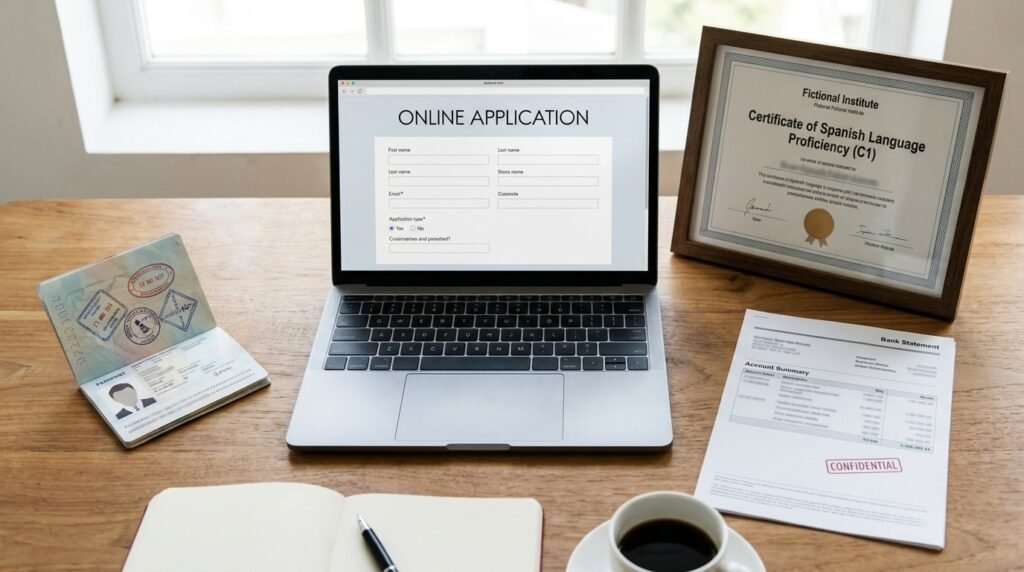
The general process from your home country looks like this:
- Confirm your route — use the official Self-Check to see whether you qualify as a recognised skilled worker or via points.
- Gather and recognise your documents, especially your qualification.
- Apply online through the German mission’s Consular Services Portal (CSP) and create an account. In some countries — India, for example — submission runs through VFS Global.
- Pay the service fee and book your appointment.
- Attend your appointment for biometrics and document verification.
- Wait for processing by the German embassy or consulate.
You generally cannot apply from inside Germany unless you already hold a qualifying residence permit (such as certain education or employment permits).
Costs and processing time
- Processing time: plan for roughly 3 to 5 months, based on current advisory estimates.
- Conversion fees (later, when you switch the card to a full work permit): typically €56 to €100, depending on the federal state.
- Budget separately for the visa fee itself, document translation, recognition checks, and your proof-of-funds amount.
After you arrive: finding a job and converting your card
Once in Germany, register your address (Anmeldung) at the local registration office, usually within two weeks. Then use your year to interview, trial jobs, and network on the ground.
When you receive a qualifying offer, you book an appointment at the Ausländerbehörde (Foreigners’ Office) to convert the Opportunity Card into a long-term work permit — for many qualified professionals, that means switching to an EU Blue Card, which offers a faster path to permanent residence.
Important honesty point on Blue Card salaries: the 2026 EU Blue Card salary thresholds are reported inconsistently across sources, with different figures for standard versus shortage occupations. Do not rely on a number you read on a blog. Verify the current official threshold directly with BAMF or the Make it in Germany portal before you assume you qualify.
What happens if you don’t find a job in 12 months?
If your year runs out but you have a qualifying job offer that cannot yet be converted — for example, because qualification recognition or your language level is still pending — you may be granted a follow-up Opportunity Card (Folge-Chancenkarte / Anschluss-Chancenkarte) for up to two additional years, subject to approval by the Federal Employment Agency. This is not an automatic extension; you need that qualifying offer.
Honest cautions before you apply
- Beware scams. Refugee-support guidance specifically warns that people are being deceived by fixers who promise to “help” with visas and work permits, take money, and disappear. No agent can guarantee you a card.
- Recognition is the silent dealbreaker. Many rejections come down to a degree that isn’t actually recognised in Anabin. Check first.
- English-only is limiting. B2 English meets the baseline but opens fewer doors than German in practice.
- No one can promise approval. The decision sits with the German mission abroad and your local Foreigners’ Office, and rules can vary between consulates and offices.
Key takeaways
- The Germany Opportunity Card 2026 (Chancenkarte) lets skilled non-EU workers live in Germany for up to 12 months to find a job — no prior offer required.
- Qualify either as a recognised skilled worker (no points) or by scoring at least 6 points.
- Show ~€1,091/month in funds; work part-time up to 20 hours/week; do 2-week trials with no limit on number.
- A1 German or B2 English is the baseline, but German massively improves both points and job prospects.
- Apply from your home country via the German mission; expect 3–5 months processing.
- Verify Blue Card salary numbers and recognition on official German sources — and avoid anyone “guaranteeing” a visa.
7. FAQ Section
-
Do I need a job offer for the Germany Opportunity Card 2026?
No. The Opportunity Card is specifically for skilled non-EU professionals who do not yet have a job offer. It gives you up to 12 months in Germany to search for one.
-
How many points do I need for the Chancenkarte?
If you apply through the points route, you need a minimum of 6 points. Recognised skilled workers with a fully recognised qualification do not need the points system at all.
-
How much money do I need to show for 2026?
The figure quoted for 2026 is at least €1,091 net per month (about €13,092 per year), usually proven through a blocked account, a sponsor’s declaration of commitment, or a qualifying part-time contract.
-
Can I work on the Opportunity Card?
Yes — part-time up to 20 hours per week in any sector, plus trial jobs of up to two weeks per employer with no limit on the number of trials.
-
How long does the application take?
Current advisory estimates put processing at roughly 3 to 5 months, so apply well ahead of when you want to arrive.
-
What happens if I don’t find a job within a year?
If you secure a qualifying job offer that can’t yet be converted, a follow-up Opportunity Card of up to two more years may be granted, subject to approval by the Federal Employment Agency.