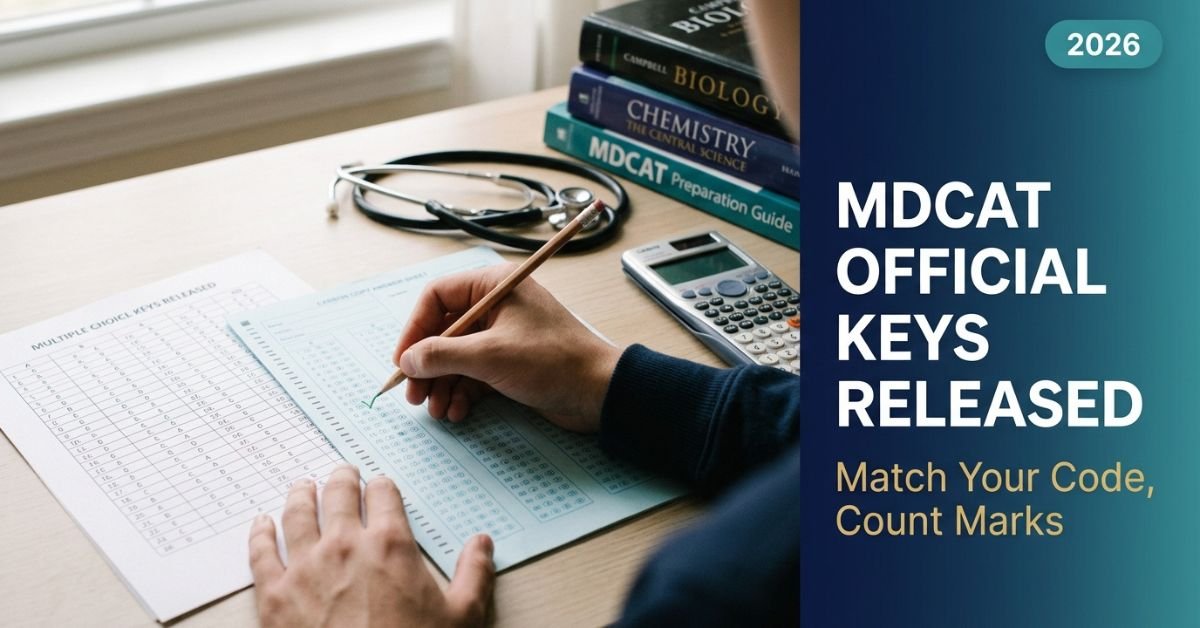
MDCAT Official Keys Released: Match Your Code, Count Marks
Every year, the same thing happens within an hour of the keys going live. Someone posts a panicked message saying they scored far lower than expected, and a few minutes later they realise they were reading the wrong column.
The MDCAT official keys are out, and the MDCAT answer key 2026 gives every candidate a chance to estimate their marks before results arrive. That estimate is only worth something if it’s done carefully. So before you count anything, slow down and read the next few sections.
Quick Answer: Download the official key published by the body that conducted your test. Find the version code printed on your question paper and use only the matching column. Compare it line by line with your carbon copy, then count your correct answers. With no negative marking, that total is your raw score.
Your Path From Test Day To Admission
- Test day — you sit the paper and keep your carbon copy
- Key release — official answers are published for each paper version
- Self-check — you count your estimated score
- Result — the official marks are declared against your roll number
- Merit lists — colleges rank applicants and offer seats
Which MDCAT Official Keys Have Been Released So Far
The keys come from the institutions that actually run the test, not from one central office. Each region’s conducting body prepares its own paper under a shared national framework, and each publishes its own key.
That detail matters more than people think. A key from another region won’t match your paper, even if the subjects and syllabus look identical.
| What To Check | Why It Matters |
|---|---|
| Conducting body | Your key must come from the one that ran your centre |
| Test year and session | Old keys still circulate online |
| Version code | Each version has its own answer order |
| Number of questions | Should match the paper you actually sat |
If you took the test at a centre outside the country, the same logic applies. Use the key from the body responsible for that centre.
Why Does Your Paper Code Matter So Much
Exam papers are printed in several versions so that neighbours can’t simply copy each other. The questions are the same or very similar, but their order is shuffled.
That means answer “B” to question 20 in one version could belong to question 134 in another. Use the wrong column and your score becomes a lottery ticket.
The code usually appears as one of these:
- A letter, such as A, B, C or D
- A number, such as 1 to 4
- A paper colour
Look at the cover of your question booklet, find the code, and write it in large letters at the top of your carbon copy. It’s a small habit that prevents a very bad evening.
How Do You Calculate Your Score With The MDCAT Answer Key 2026
Think of the key as a grid. Each row is a question number and each column belongs to one paper version. Your job is to walk down a single column.
- Open the official key from your conducting body.
- Locate your version’s column and ignore every other one.
- Lay your carbon copy beside it, starting at question 1.
- Mark each match with a small tick. Skip anything that doesn’t match.
- Add up the ticks. That’s your raw score.
Then do it once more, ideally after a break. Tired eyes skip rows, especially somewhere in the middle of the paper.
For a cleaner check, count subject by subject. If your subject totals add up to the same overall number, you can trust your count far more.
Is There Negative Marking In MDCAT
Under the current format, no. A correct answer earns a mark, and a wrong answer simply earns nothing.
This is worth stating plainly because older formats and other entrance exams around the world do deduct marks. Students who’ve prepared for several tests sometimes carry that rule into the wrong exam.
So don’t subtract anything for wrong answers. Count only what you got right.
It also means you can stop worrying about your guesses. A guess that missed didn’t cost you a thing.
What Does A Question With Two Accepted Answers Mean
Now and then, a row in the key shows two options instead of one. That isn’t a printing error.
It usually means the examiners agreed that a question could fairly be read in two ways, or that two options were both defensible. Instead of penalising anyone, they accept both.
If you chose either of the listed options, give yourself the mark. It might only add one or two points, but in a competitive merit list, one or two points can separate hundreds of applicants.
How Many Marks Do You Need To Pass MDCAT
The regulator sets a minimum percentage for each programme. Under the policy in recent cycles, it has been 55% for MBBS and 50% for BDS.
On a paper of 180 marks, that works out as follows:
| Programme | Minimum Percentage | Minimum Marks Out Of 180 |
|---|---|---|
| MBBS | 55% | 99 |
| BDS | 50% | 90 |
Always confirm these figures against the current year’s official policy, as regulators can revise them.
Passing is the entry ticket, not the seat itself. Your final chances depend on your aggregate, the number of applicants and the seats on offer that year.
Is Your Self-Calculated Score The Same As Your Result
It’s close, but it isn’t official. Your count is an informed estimate. The result declared against your roll number is the one that counts.
A few things can create a small gap. The examiners might revise an answer after review. A faint bubble on your original sheet might not have registered the way you remember. Or you may simply have miscounted.
The sensible approach is to think in ranges. If you counted 140, expect something between roughly 138 and 142, and let the result settle it.
What If You Think An Answer In The Key Is Wrong
Disputed questions come up in almost every large exam. A textbook says one thing, the key says another, and discussion groups fill up with screenshots.
Arguing online won’t change your score. What helps is following the official process, if your conducting body announces one.
Keep your case tidy:
- Note the question number and your version code
- Find support in a standard textbook that follows the official syllabus
- Submit only through the channel the conducting body announces, within its deadline
If no review process is announced, the published key stands until results are declared.
When Will The MDCAT Result 2026 Be Announced
Only the conducting body can confirm that, and until it does, any exact date you see is a guess.
What’s reasonable to expect is that results follow the keys fairly quickly, often within a week or two, once answers are finalised and sheets are processed. Different regions don’t always publish on the same day.
Rather than chasing rumours, check the official notices of the body that ran your test every day or two.
How Much Does The MDCAT Score Affect Your Aggregate
Quite a lot. In most admission formulas, the entrance test carries the heaviest weight, with school and college results making up the rest.
That’s why a handful of extra marks on the test can do more for your aggregate than a similar gain in your earlier exams. Each correct answer is simply worth more in the final calculation.
The exact weighting depends on the admission policy that applies to you, and it can differ by region, by type of college and for overseas or foreign seats. Use the formula in the current official prospectus rather than a figure you saw in a group chat.
Does This Apply To Students Applying From Abroad
Yes, and overseas applicants often have more to manage. Many take the test at centres outside the country, or apply for seats reserved for overseas nationals or international students.
The self-check method is exactly the same: right key, right column, careful count. What differs is the paperwork that follows. Foreign-seat and overseas-quota admissions often ask for extra documents, such as equivalence certificates for foreign school qualifications, passport copies or proof of residence abroad.
If you studied under a different school system, such as British, American or Gulf curricula, start your equivalence process now. It can take longer than the result itself.
The same approach also applies to multiple-choice entrance tests in other countries. Always match your version, check the negative-marking rule, and treat your own count as an estimate.
Where Should You Download The Key To Stay Safe
From the official website of the body that conducted your test. Nowhere else carries the same authority.
Reposted files are everywhere after a big exam. Some are fine. Others are last year’s key, the wrong region’s paper, or “expected answers” made up by someone guessing.
Before you trust a file, ask:
- Does it name the body that ran your test?
- Does it show the right year and session?
- Is there a column for your version code?
If any answer is no, go back to the official source.
What Should You Do While Waiting For The Result
Use the time well. Once results land, admissions move quickly, and students who prepared early have a much calmer experience.
- Keep your roll number slip safe. You’ll need it to see your result.
- Collect your documents: identity papers, school and college certificates, photographs and any domicile or residence proof.
- Scan everything into clear, readable files.
- Build a shortlist of colleges that fit your expected aggregate.
- Plan an alternative if your score is close to the line, whether that’s a different programme or another attempt.
A week of quiet preparation is worth far more than a week of refreshing a results page.
Key Takeaways
- The MDCAT official keys are out, published by each conducting body for its own papers.
- Use only the column for your version code, or your count won’t mean anything.
- No negative marking under the current format: count correct answers only.
- A row with two letters means both answers are accepted.
- Recent minimums have been 99 of 180 for MBBS and 90 of 180 for BDS. Confirm them against the current policy.
- Your self-count is an estimate, and the official result decides admission.
- Overseas applicants should start equivalence and extra paperwork early.
Your Next Steps
- Find your version code and write it on your carbon copy.
- Download the key from your conducting body’s official website.
- Count your score twice, then check it subject by subject.
- Compare your total with the minimum marks for your programme.
- Estimate your aggregate using the current official formula.
- Organise your documents, including equivalence papers if you studied abroad.
- Check official notices regularly for any review window and the result.
Frequently Asked Questions
What if I lost my carbon copy?
Then you can’t calculate an accurate score, and guessing from memory usually misleads. Wait for the official result, which is based on your original answer sheet.
Can I use a friend’s key if they sat the same test?
Only if they sat the same version at a centre run by the same body. Otherwise the answer order won’t match yours.
Can the answer key change before the result?
It can. Examiners sometimes revise a small number of answers after review, which is why self-scores are treated as estimates.
Is the result checked by roll number?
In most cases, yes. Keep your roll number slip safe, because you’ll also need it during admissions.
Do overseas candidates get a different key?
They get the key for the paper they actually sat. If a centre abroad used a separate version, the conducting body will publish a matching column or key for it.