USA Visa Bulletin Explained 2026: Priority Dates, Cutoff Charts & Green Card Wait Times
Thousands of families, workers and students open a government chart each month hoping to find at least one small difference a date which will move forward.
The date is the determining factor as to whether one can finally submit their application to permanently reside in United States or they will have to wait; in some cases, some years.
This graph is referred to as U.S. Visa Bulletin
It does not grant visas and neither does it refuse them. Rather it operates an international queue induced by immigration statute. Knowing how to make it work will enable the applicants to know where to be and what might be in store.
What the U.S. Visa Bulletin really is
The Visa Bulletin is a monthly journal that is released by the U.S. Department of State. It demonstrates when the immigrant visas (green cards) are on offer to various groups of applicants.
Due to the constraint in immigration legislation in the United States to issue a particular number of green cards every year, the government is not able to grant everyone at once. Rather applications are put in a queue. The Visa Bulletin informs the applicants of the distance that the line has gone.
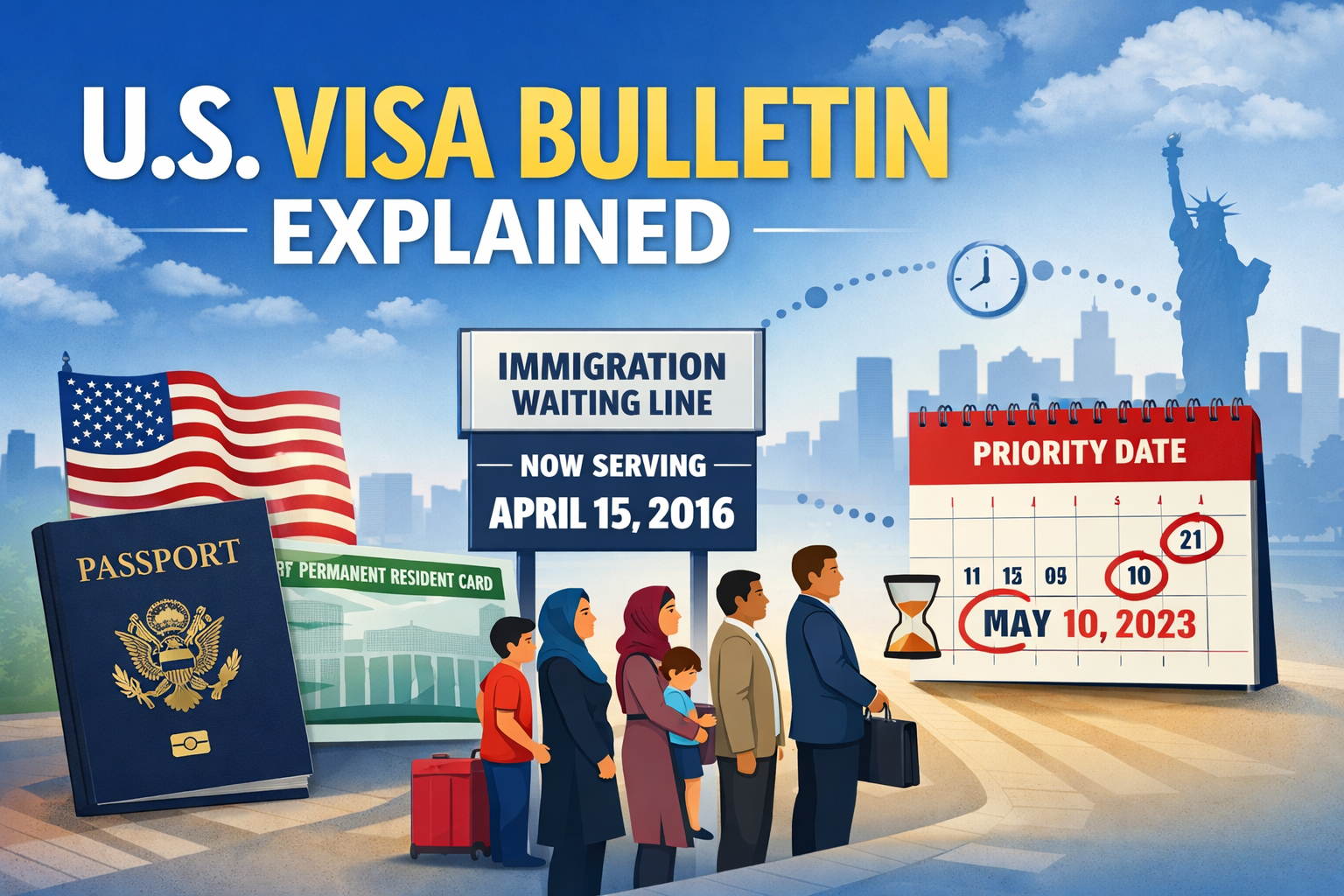
It can be considered as a ticket system.
Once your name is called, then your case may proceed.
The Reason why the United States operates a Waiting List
There is a common misconception that immigration applications are done in a strictly First in First out manner. The U.S. immigration is in reality a matter of quota based system that is legally determined.
The United States has set a restricted quantity of immigrant visas which it allocates each year to:
- Family-sponsored applicants
- Employment-based workers
- Diversity categories
- There is also per-country cap.
This implies that in the case of highpopulated countries, the applicants can take longer due to the fact that many people apply in these countries.
This demand is controlled by having a Visa Bulletin to ensure that this demand is fair and transparent.
Knowledge of the Priority Date
The priority date is the most critical idea in Visa Bulletin.
Your place in line is effectively your priority date.
It is usually the date when:
- An application was made as a family petition, or
- An employment petition or a labor certification was filed.
Ever since that time you have been waiting to be allocated a visa number.
In case your priority date surpasses the one mentioned in the Visa Bulletin, you can proceed to the second stage of processing.
The Visa Bulletin chart How to read the Visa Bulletin chart
On the surface, the chart appears complex, although it has a straightforward logic.
Each table contains:
- Visa category (family preference or employment category)
- Country of chargeability
- A cutoff date
In order to use the chart, an applicant has to:
- Find their category
- Find their country column
- Compare the listed date against their priority date.
In case your case is dated later than indicated on the chart, then your case is said to be current at that stage.
Final Action Date vs Dates of Filing
The presence of two charts can be considered one of the most perplexing aspects of the Visa Bulletin.
Dates for Filing
This chart informs you that you can file some immigration documents like the adjustments of status applications as long as immigration authorities permit it during the given month.
Final Action Date
This chart indicates at what time the government will be able to pass and grant the green card.
In simple terms:
- Date of filing = paper work may commence.
- Date of final action = approval can occur.
The filing chart cannot be used every month, and this is why the applicants should follow the official instructions on immigration regularly.
Family-based and Employment-Based Categories
The immigrant visas are subdivided into preference groups.
Family-Based Examples
- Homeless children of U.S citizens.
- Children and spouses of the permanent residents.
- Siblings of U.S. citizens
Employment-Based Examples
- Very talented employees.
- Advanced degree workers
- Experienced employees and specialists.
The quotas are divided among each category hence some of them travel faster than others.
What Current (C) and Unavailable (U) =
At other times the Visa Bulletin does not even have a date.
Current (C) indicates that there are visas that are instantly available in that classification.
There is no need of waiting a cut off date by the applicants.
Unavailable (U) refers to the annual quota being attained and processing has to stop until such time there is a new allocation period.
Why Dates move backward (Retrogression)
Dates do not always move forward, and this is noticeable by the applicants. Sometimes they go gradually backwards. This is referred to as retrogression.
The retrogression occurs when the demand is greater than anticipated. The government slows the approvals so that it can remain within the legal limit in a year.
This does not cancel a case.
It does not stop but just slows down until additional visa numbers become available.
The Explanation of the Waiting Times by Country
Country variation is one of the most important aspects of Visa Bulletin.
Majority of countries tend to build longer queues when there are higher instances of applicants.
There are other people who might have lesser waiting time though they are in the same category.
This disparity is due to the fact that the immigration law has a limit of the number of visas that can be granted to any country in any given year.
Consequently, two candidates with the same credentials are likely to have extremely different schedules based on their place of origin.
What Does It Mean to Have your Priority Date come Current
Once your date is the date of your case, you may then proceed to the next stage.
This can include:
- Status adjustment within the United States.
- An embassy consular processing.
An immigrant visa or green card can be given after the required checks and interviews, as well as review of the documentation, and when the eligibility requirements have been fulfilled.
The fact that one is up-to-date does not necessarily confer approval.
It just enables processing to persist.
Observing Visa Bulletin Updating Frequency.
The Visa Bulletin is issued on a monthly basis
Changes depend on:
- Number of pending cases
- Annual visa limits
- Demand projections by the government.
There are those months that may reflect great movement and those that do not change.
Some General Misconceptions about the Visa Bulletin.
Most applicants misunderstand the bulletin and believe that it forecasts dates of approval
As a matter of fact, it merely displays availability of visa numbers.
It does not:
- Guarantee a green card
- Determine the exact time of the interview.
- Replace eligibility requirements.
It is a booking system but not a choice.
The importance of the Visa Bulletin
The Visa Bulletin impacts the immigration long-term planning.
Families base their relocation plans, career and education upon it.
To the employers it affects the hiring schedules and the workforce planning.
To the applicants, it gives them visibility into a complicated legal system.
Even minor adjustments in dates will have a tremendous effect on thousands of people around the world.
Frequently Asked Questions
-
What is a priority date in U.S. immigration?
It is the date your immigration request was filed and determines your point in the waiting line.
-
Why does the Visa Bulletin move slowly?
Because immigration instrument limits how many green cards can be issued each year.
-
Can the Visa Bulletin move backward?
Yes. This is called transformation and pass off when demand overstep available visas.
-
Does “current” mean my visa is approved?
No. It effectuate a visa number is forthcoming and process can continue.
-
Which chart should applicants follow?
Applicants must result official monthly manual indicating whether the formation chart or final activity chart applies.
-
Why do some countries wait longer?
Due to per-country Limitation combined with higher postulation from certain part.
-
How often should applicants check the Visa Bulletin?
Monthly, since it modify every month and may impact eligibility to carry on.
-
What happens after the date becomes current?
The person may file or continue process, including consultation and background assessment.
Final Thoughts
The U.S. Approve News report is not a prediction tool and not an approving notice.
It is a scheduling performance created to manage immigration demand within sanctioned limits.
Understanding how it works allows applicants to set realistic require and avoid confusion about timelines. While waiting periods can vary widely, the bulletin provides transparency into a activity affecting millions of people worldwide.